© Kaboompics
November 4, 2026
Marianne Waldenfels
Women experience sleep disorders more often than men — but stress and menopause aren't always to blame. Gynecologist and author Dr. Judith Bildau explains the often-overlooked causes, when to seek medical help, and what magnesium, valerian, and sleeping pills can actually do.
Lying awake at night, ruminating for hours, waking up exhausted in the morning: for many women, poor sleep has long since become part of everyday life. Some attribute the problem to stress, others to hormonal changes. And quite a few have simply come to accept that they just sleep badly.
Gynecologist Dr. Judith Bildau believes it is a mistake that sleep problems in women are so often accepted as an inevitable side effect of a demanding lifestyle or hormonal shifts. In her practice, she regularly sees patients who have been sleeping poorly for years without anyone looking more closely at the underlying causes — causes that, in women, can include conditions that frequently go undetected.
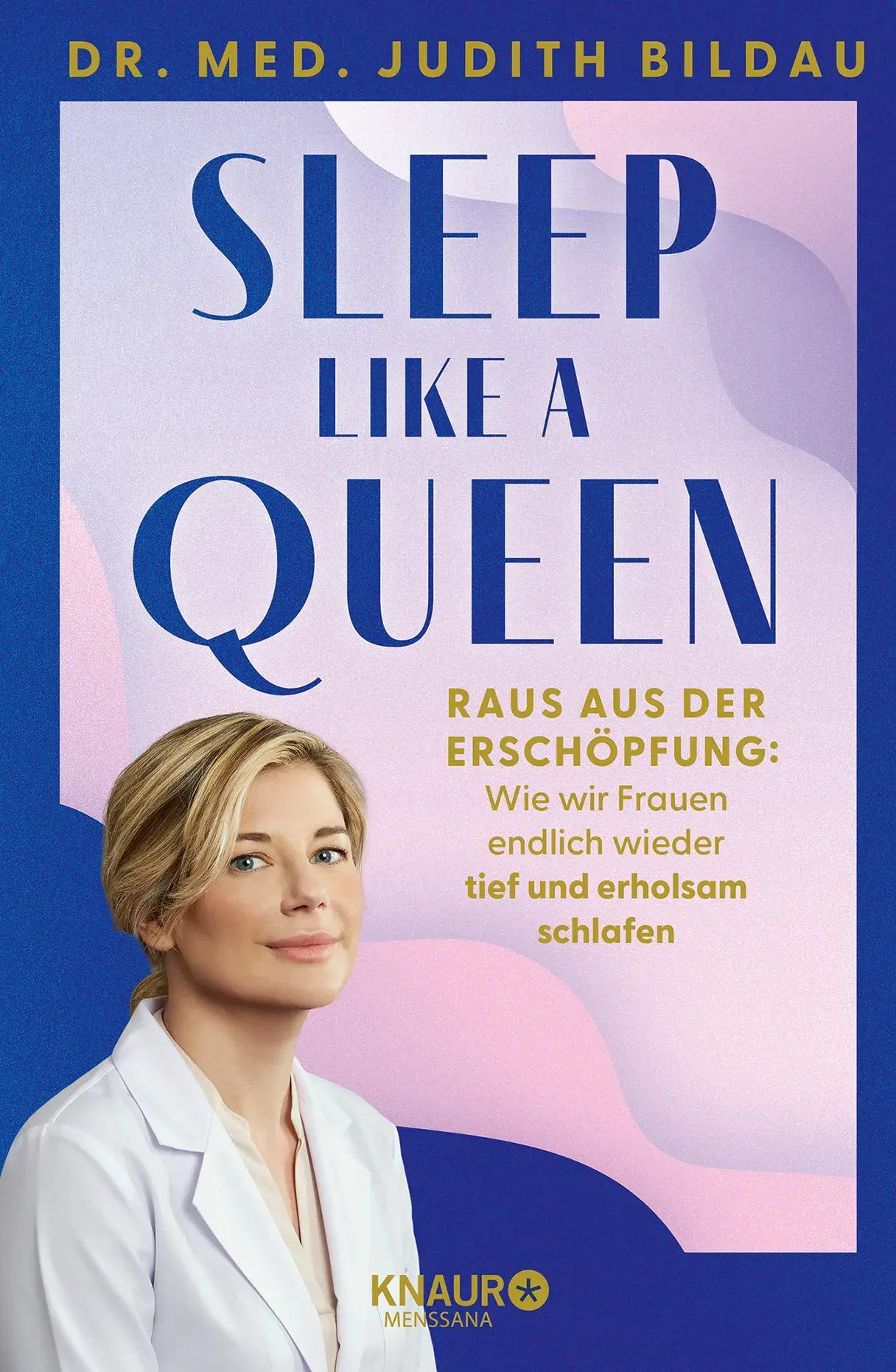
In her new book Sleep Like A Queen (Knaur MensSana), Bildau explores the medical particularities of female sleep. In this interview, she discusses the influence of hormones and mental load, the often-overlooked symptoms of sleep apnea, and why sleep disorders deserve targeted treatment rather than passive acceptance.
Dr. Bildau, you are a gynecologist. What motivated you to write a book about women's sleep?
Although I have always tried to work holistically in my gynecological practice — accompanying and caring for women as a whole — it was only over the years that I truly came to appreciate just how profoundly poor sleep affects women's wellbeing — their entire daily life, in fact.
For a long time, I hadn't fully registered that sleep disorders are particularly a women's issue — that more women than men are affected. But the more intensively I cared for my patients, the more clearly I saw that poor sleep can be a heavy burden for women at every stage of life: for one woman it stems from the entirely natural hormonal fluctuations of her cycle; for another, from total overload; for another still, from the hormonal upheaval of perimenopause; and for yet another, from a sleep-related breathing disorder or restless legs syndrome.
Yet one pattern keeps coming up again and again: most of the women affected had, at some point, simply made their peace with their sleepless nights — resigned to the idea that women just sleep badly and there's nothing to be done about it. That is something I really want to change.
What distinguishes female sleep from male sleep biologically? And what roles do evolution and mental load play?
Female sleep is more susceptible to disruption than male sleep. One evolutionary biology theory holds that women needed to be — and still are — more easily roused, because they bore primary responsibility for their offspring, particularly in early life, and had to be alert to danger in time. On top of that, hormonal influences on sleep have always been a factor.
In recent decades, female sleep has deteriorated further. It's hardly surprising: women continue to shoulder the greatest burden within the family while also sharing financial responsibility — and, not to be underestimated, they face enormous societal pressure to meet expectations on all fronts. It is therefore no surprise that switching off at night is becoming increasingly difficult.
How do estrogen, progesterone, and testosterone affect sleep?
Sex hormones have an enormous influence on female sleep. Estrogen supports deep sleep and REM sleep, while the breakdown products of progesterone have a calming, sleep-promoting effect via GABA receptors. Studies also show that testosterone can have a sleep-promoting and stabilizing effect in women.
Many girls and women report poor sleep just before and during their period, which is directly and indirectly attributable to hormonal changes. And in perimenopause — the transition to menopause — studies show that just over half of all women experience sleep problems.
Many women lie awake at night fearing they won't be able to sleep. How does this vicious cycle develop?
It often begins very gradually. At first, nights grow more restless as thoughts and worries make it hard to fall asleep and stay asleep. This is hardly surprising, given that women still carry the main burden of caregiving, are expected to be constantly available and reachable, and feel responsible for everyone and everything.
After a few sleepless nights, they fairly quickly notice the first physical and emotional limitations — and with that, understandably, comes a growing desire to finally sleep peacefully and restoratively again in order to keep managing daily life. Gradually, more and more pressure builds around getting a good night's rest. The problem with sleep, however, is that it cannot be forced. It comes when we let go and relax. The more attention we place on it, the more alertness, stress, and anxiety around it grow.
Sleeping pills can be helpful in acute situations but do not address the underlying problem. This is where cognitive behavioral therapy (CBT) and Acceptance and Commitment Therapy (ACT) come in. They help people examine distressing thoughts critically, reduce the performance pressure around sleep, and gradually rebuild a more relaxed relationship with it. Specific tools are also developed to help reassociate the bed with rest and recovery rather than with stress and tension.
When are sleeping pills appropriate, and what mistakes do you observe in how they are used?
I regularly speak out against black-and-white thinking in medicine, because it fails to account for the individual needs of patients. Sleeping pills have a legitimate pharmacological place, and "demonizing" them is not medically sound. What is clear is that they must be prescribed by a doctor, that prescriptions should be reviewed regularly, and that irresponsible long-term prescribing must be avoided under all circumstances.
That said, sleeping pills can be medically appropriate in acute situations, on an as-needed basis, or in combination with psychological therapies, and they can significantly improve the quality of life of those affected. There are also continually exciting new developments in this area. In my book, I discuss, among other things, new active substances that act specifically on the wake receptors in the brain and, based on current studies, do not carry a comparable risk of tolerance or dependency as the "old" sleeping pills.
One mistake — if one may call it that — I frequently see is that sleeping pills are often taken too late at night. This can lead to pronounced tiredness and a hangover effect the following morning.
Restless legs, thyroid issues, nocturia: which physical causes should be investigated when sleep problems arise?
I don't want to be prescriptive here, because women's sleepless nights are as individual as the women themselves. What I do want is for the causes of female insomnia to be examined more carefully and not simply dismissed. Even just listening carefully, taking a thorough medical history — ideally supported by specific sleep questionnaires — and conducting a careful physical examination usually yields important insights into the cause.
From there, further investigations can follow. In addition to a comprehensive blood count, checking iron levels and micronutrients can be useful, as can — depending on the symptoms — a hormone analysis timed to the relevant day of the cycle, including thyroid values. As extended diagnostics, a polysomnographic examination — that is, a sleep study, which can now also be conducted at home using mobile devices — is recommended in many cases.
You write that sleep-related breathing disorders often go undetected in women. Which symptoms are being missed?
This is once again a very telling example of the "gender health gap." Classic sleep apnea — loud snoring, sometimes with audible pauses in breathing — is still widely regarded as the sleep-related breathing disorder. Yet women typically do not present these "classic" symptoms at all. Instead, they report non-specific complaints — and as a result, are often never diagnosed in the first place. They much more frequently describe feeling completely wrecked when they wake up in the morning, with low energy, frequent headaches, and a general sense of malaise.
The standard sleep questionnaires — important screening tools — are also not designed with female symptoms in mind. In women, it is often not even a partial or complete collapse of the upper airway that occurs, but "only" an increased airway resistance, caused by female anatomy as well as the hormonal changes of peri- and postmenopause. Many women therefore have no idea that something serious is happening during the night — and that this is precisely why they feel unwell during the day.
At what point should women with sleep problems seek medical help?
My hope is that women take their sleep seriously as a matter of course and treat it as an important resource — not as another perfectionism trap, but as something genuinely worth protecting. Unfortunately, I see many women who have been struggling with insomnia for a very long time and have spent far too long trying to manage on their own.
Just as often, I also see women who have already tried to get medical help but simply haven't been taken seriously or haven't received adequate support. I would encourage any woman who notices her sleep deteriorating to seek medical advice. A chronic sleep disorder does not need to have fully developed before a woman is entitled to medical support.
What does a sleep diary offer compared to a smartwatch or sleep apps?
Many women swear by gadgets that track their sleep and find it valuable to gain detailed insights into their sleep this way. Others, however, find it more stressful to have their poor nights recorded and to wake up to worrying numbers the following morning.
A sleep diary, which should be kept for at least two weeks to build a useful picture, often feels less threatening. And beyond that, a diary can also capture feelings, thoughts, and general daily wellbeing — making it considerably more individual and personal than simply measuring sleep efficiency and the proportions of individual sleep phases.
Which herbal sleep remedies and micronutrients can help — and where is more being promised than the evidence actually supports?
Micronutrients play a role, among other things, as cofactors in the production of neurotransmitters important for restorative sleep. These include magnesium, zinc, B vitamins, and vitamin D, among others. Amino acids such as tryptophan, L-theanine and glycine can also offer positive support. Calming and sleep-promoting phytopharmaceuticals such as valerian, lemon balm, lavender, and passionflower work via GABA metabolism and can be combined well with one another.
That said, targeted supplementation with micronutrients and amino acids, as well as supportive phytopharmaceutical therapy, is most useful for mild to moderate nighttime restlessness and sleep disturbances. When a chronic sleep disorder is already present, supplementation — regardless of what is promised on social media — is usually no longer sufficient as a standalone treatment.

© Kim Keibel
Dr. Judith Bildau is a gynecologist and expert in women's health, gender medicine, longevity, and hormonal counseling. The specialist in gynecology and obstetrics runs a practice in Rome and Tuscany.

A Hamburg orthopedic surgeon harvests tiny cartilage samples from the ear and injects them into arthritic knees. In this interview, Dr. Hans Olaf Baack explains who may benefit, what early studies show and why he avoids making promises
Christine Bürg & Marianne Waldenfels
An interview with
Dr. med. Hans Olaf Baack

Burning or watery eyes despite regular use of eye drops? Ophthalmologist Dr. Christine Heun explains what causes the symptoms, why women are more frequently affected, and which new treatments are available.
Christine Bürg & Marianne Waldenfels

An interview with
Dr. Christine Heun

When fingers tingle or go numb at night, carpal tunnel syndrome may be to blame. Hand surgeon Prof. Dr. Helen Abel explains when a splint is sufficient, why waiting too long can cause permanent nerve damage, and what the chances of recovery are after surgery.
Christine Bürg & Marianne Waldenfels

An interview with
Prof. Dr. med. Helen Abel

A nasal spray containing synthetic mebufotenin, a psychedelic also found in toad secretion, has shown promising results after just one dose in patients with treatment-resistant depression. Psychiatrist Prof. Dr. Andreas Menke explains what makes the substance different from other psychedelics and how significant the findings really are.
Christine Bürg & Marianne Waldenfels

An interview with
Prof. Dr. med. Andreas Menke