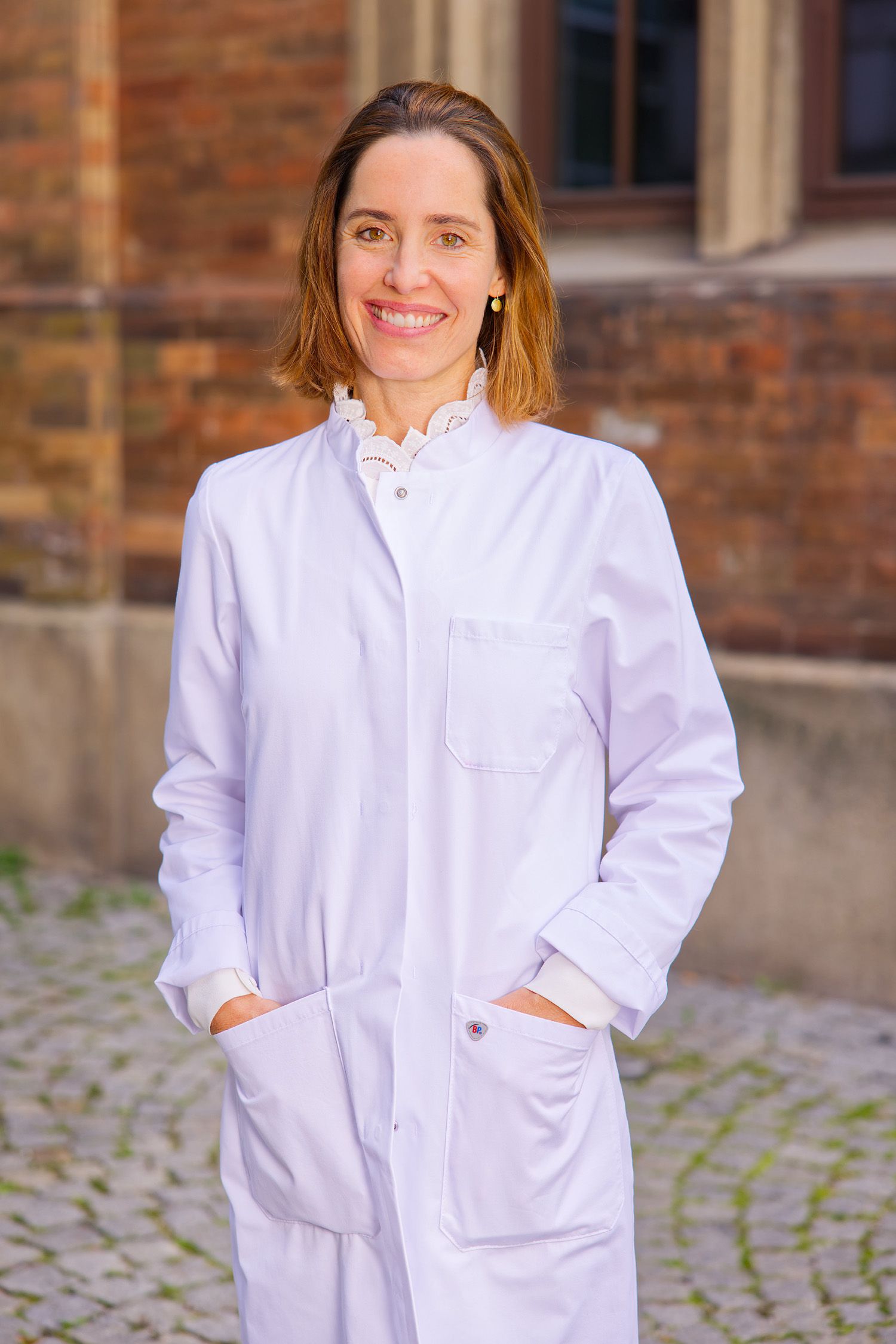
Breast Reconstruction After Cancer: A Surgeon on the Decision No Woman Should Rush
Implant or your own tissue, now or after treatment — or perhaps no reconstruction at all? Plastic surgeon Dr. Juliane Bodo explains what role radiation plays, what risks to expect, and why no one should make this decision under pressure.
Does a reconstructed breast always look artificial? Does the decision have to be made right at the time of cancer surgery? And does every woman need breast reconstruction after a mastectomy in order to feel well again? Many assumptions about breast reconstruction after cancer persist, adding to the uncertainty that those affected face at a time when so many decisions must already be made at once.
Dr. Juliane Bodo, a specialist in plastic and aesthetic surgery, advises women in exactly this situation. In this interview, she explains how the procedures differ, how to recognize a good clinic, whether sensation returns to the reconstructed breast, and which misconceptions she encounters most often in her consultations.
After the Diagnosis: No Decision Under Pressure
Dr. Bodo, what do you advise a woman who has just received her diagnosis and feels overwhelmed by the decision of whether or not to have breast reconstruction?
First and foremost, I tell every woman not to let herself be rushed. A breast cancer diagnosis is already an enormous psychological burden. The decision for or against breast reconstruction does not have to be made immediately — getting the right oncological treatment is what matters most at this stage.
Today there are very good procedures — both with implants and with the patient's own tissue. But it is equally valid to decide against reconstruction altogether.
My most important piece of advice is this: the decision should be guided by the patient's own wishes. Is she very afraid of losing her sense of femininity, or is that less of a concern for her right now? The decision belongs to her personal situation and medical circumstances — not to the expectations of others. We are always available to talk things through with our patients.
Not every woman chooses to have her breast reconstructed after a mastectomy. What is your experience of this, and when do you personally advise against reconstruction?
In Germany, only 37% of women opt for reconstruction, compared to 50% in the USA. In my view, that is a low figure. I encounter very different motivations. Some women want to restore their familiar body silhouette and see reconstruction as an important part of coming to terms with their illness. Others prefer to have as few additional procedures as possible, feel comfortable without reconstruction, or simply want to focus entirely on their recovery first.
I believe it is essential to accept these different needs without judgment. A woman is no less feminine if she decides against breast reconstruction.
I would particularly advise against reconstruction — or recommend deferring it — when the medical conditions are unfavorable, when significant comorbidities or a high surgical risk are present, or when a patient has expectations about the outcome that cannot realistically be met.
Any planned radiation therapy must also be factored into the consultation. Sometimes it simply makes medical sense to complete oncological treatment first and then revisit the question of reconstruction at a later, more considered stage.
Well Prepared for the Consultation
What should a patient know before making her decision, and what questions should she ask during the consultation?
Above all, she should understand which options are available in her individual situation and what their respective advantages and disadvantages are. I recommend asking, among others, the following questions:
• Which reconstruction procedures are suitable for me?
• How does my cancer treatment — particularly any planned radiation — and my general state of health affect the planning?
• How many operations will likely be needed?
• What will the reconstructed breast look and feel like compared to the other breast?
• What risks and possible follow-up procedures are involved?
• How long does healing and recovery take, and when can I return to work or exercise?
• What alternatives do I have if I decide against reconstruction?
It is very important to me that patients are informed not only about the operation itself, but also about the path that follows. Reconstruction is often a multi-stage process, and there are risks that can negatively affect the aesthetic outcome. Patients should be able to assess this realistically from the very beginning.
How do women find a good clinic for breast reconstruction, and how can they recognize quality?
I recommend looking for a certified breast center with well-established interdisciplinary collaboration among gynecology, oncology, radiology and plastic surgery. It is crucial that reconstructive options are incorporated into treatment planning at an early stage, so that patients are not only informed about their options after the mastectomy has already taken place.
On the plastic surgery side, patients should look for the appropriate specialist qualifications and demonstrable experience with the specific reconstruction procedure. A good clinic will be able to offer different procedures or refer to a specialized center when needed.
Breast reconstruction at the time of mastectomy versus later: what are the arguments for each approach, and what role does radiation play?
With immediate reconstruction, the breast is rebuilt as part of the mastectomy itself. The advantage is that the patient does not have to live without a breast for an extended period, and the skin — and, where applicable, the nipple — can often be preserved, provided this is oncologically safe. For some women, this offers significant psychological relief. However, immediate reconstruction is not medically appropriate or feasible in every situation.
With delayed reconstruction, the cancer treatment is completed first. This can be particularly advantageous when the further course of therapy is not yet certain, or when tissue conditions or wound healing are initially unfavorable.
Radiation plays a central role in this decision. It can alter the skin and subcutaneous tissue, impair wound healing, and significantly increase the risk of capsular contracture or other complications following implant reconstruction. Autologous tissue reconstructions can also be affected by radiation, though the impact and associated risks differ.
There is therefore no universally correct answer. Ideally, the decision should be made before the mastectomy, jointly within the interdisciplinary team. In selected cases, a staged approach is also an option, in which the definitive reconstruction takes place at a later point.
Implant or Own Tissue: Comparing the Procedures
Implant or own tissue: how do the procedures differ, and what determines the choice?
With implant reconstruction, the breast is built up using a silicone implant, supported if necessary by a tissue expander that initially creates space for the eventual implant. The procedure is often less extensive than autologous tissue reconstruction.
However, a foreign body remains in the body, and follow-up procedures may become necessary over time — for example in cases of capsular contracture, implant problems, or changes in breast shape. When radiation is required, an implant is generally not the first choice.
With autologous tissue reconstruction, the patient's own tissue — for example skin and fat from the lower abdomen or thigh — is used to shape the breast. A commonly used technique is so-called flap reconstruction. The advantage is that the breast feels natural and changes with body weight and age. However, the operation is more complex, takes longer, and leaves an additional scar at the donor site, and specific risks also apply.
The choice depends on a number of factors, including anatomy, available tissue reserves, planned or already completed radiation, general state of health, and personal preferences. Lifestyle and willingness to undergo a longer recovery period also play a role. My goal is not to favor one procedure over another, but to find the one that best suits the patient both medically and personally.
How important are autologous fat transfer and nipple reconstruction to the final result?
Autologous fat transfer is an important tool for refining the reconstructed breast. Fat is liposuctioned from another area of the body, processed, and then introduced into the breast. This allows contours to be improved, minor asymmetries to be corrected, and the transitions between the reconstructed breast and the chest wall to be smoothed out. In selected cases, fat transfer can also help improve tissue quality in irradiated tissue. However, not all of the transferred fat will establish itself permanently, so multiple sessions may be necessary.
Reconstruction of the nipple and areola often forms the final step. The nipple can, for example, be shaped from local tissue, while the areola is frequently reconstructed through medical tattooing.
These details can make a significant difference to the overall appearance, as they visually complete the breast. In my view, they are the finishing touch of the entire reconstruction.
Neither of these steps is a minor detail. They help to improve the outcome, since a breast without a nipple never looks truly natural.
Risks, Sensation, and Follow-Up Care
What complications should women realistically expect, and how often are further procedures necessary?
As with any operation, breast reconstruction carries risks. These include wound healing problems, infections, hematomas, and fluid accumulations. With implants, capsular contracture, implant displacement, or an unsatisfactory breast shape can additionally occur.
With autologous tissue reconstruction, possible complications include fat necrosis, circulatory problems in the transplanted tissue, and complications at the donor site, among others. In rare cases, an implant may need to be removed or a tissue transfer may fail.
Individual risk levels depend on factors such as the procedure chosen, comorbidities, smoking, radiation, and tissue conditions. It would therefore be misleading to cite a single complication rate that applies to all patients and all reconstruction procedures.
Patients should also be aware that breast reconstruction often involves several stages. Contour corrections, autologous fat transfer, adjustment of the opposite side, or nipple reconstruction may all be part of the process. This is not automatically a sign that the first operation was unsuccessful — it can simply be part of a planned reconstruction concept. What is essential is that the patient receives a realistic picture of the entire treatment pathway before the first procedure takes place.
Does sensation return to the reconstructed breast?
This is an important question, because sensitivity is often underestimated during planning. After a mastectomy, the skin and nipple are frequently much less sensitive or completely numb, as sensory nerves may have been severed. Even after reconstruction with an implant or autologous tissue, the original sensation does not return automatically.
Some spontaneous recovery of sensitivity may occur over time. How pronounced this is depends on factors such as the surgical technique used, which nerve structures were preserved, and individual healing processes.
No operation can guarantee that sensation will be unchanged, but there are indeed women who regain completely normal feeling in the skin.
Does breast reconstruction make follow-up care or the detection of a relapse more difficult?
In principle, breast reconstruction should not prevent guideline-compliant oncological follow-up care. The structure of follow-up depends on the original cancer diagnosis and the surgery performed.
After a mastectomy, follow-up care is generally structured differently than after breast-conserving surgery. For a reconstructed breast, the focus is particularly on clinical examination and the assessment of any possible new changes. If there is a specific suspicion, ultrasound, MRI or other appropriate imaging procedures can be used. Which examinations are routinely required depends on the individual situation and the reconstruction procedure chosen.
Patients should know that any new lumps, swelling, skin changes, persistent pain, or other noticeable changes must be investigated medically. With implants, additional examinations to assess the implant may also be necessary where appropriate. Good coordination between the breast center and the treating gynecologist is therefore particularly important.
What myths about breast reconstruction do you hear most often in your consultations?
A common myth is that breast reconstruction always produces an artificial-looking result. This is simply not true. With today's techniques, very natural results can be achieved. At the same time, it is worth being honest: a reconstructed breast need not look or feel identical to a natural breast.
Another misconception is that reconstruction delays cancer treatment or fundamentally makes a relapse harder to detect. With careful planning and close collaboration with the oncological team and gynecologist, reconstruction does not increase the risk of recurrence.
Some women also believe they must decide immediately after the mastectomy. In many cases, however, reconstruction at a later stage is entirely possible. Equally, the assumption that immediate reconstruction is always the better option is not correct. The ideal timing depends on the individual tumor situation and the course of further treatment.
Perhaps the most important myth of all, though, is that every woman needs reconstruction after a mastectomy in order to feel fully like a woman again. Femininity and body image are deeply personal. Reconstruction can make a tremendous difference — but it is a personal choice, not a prerequisite for feeling comfortable in one's own body again.