© Magnific
October 21, 2026
Marianne Waldenfels
A new AI from Boston can assess the mortality risk of cancer patients from a single photo of their face. In the highest-risk group, more than half died within three months. Most striking of all: the AI focuses on some of the same facial regions that Hippocrates described 2,400 years ago.
Sometimes you can tell at a glance that something is wrong with a person. The skinlooks pale, the eyes tired, the features somehow changed. Doctors have paid attention to such signs for thousands of years. But how much do they actually reveal about a person's health — and can they even hint at what the future holds?
That is precisely the question researchers at the Mass General Brigham hospital network in Boston set out to answer — using an artificial intelligence that requires neither a blood sample nor an elaborate examination. It evaluates facial features whose medical significance has until now only been partially understood.
The results were published on October 19, 2026, in the journal The Lancet Digital Health. The work was led by radiation oncologist Dr. Raymond Mak and Hugo Aerts, director of the Artificial Intelligence in Medicine program at Mass General Brigham.
The system is called FAHR-Face, short for "Foundation Artificial Intelligence for Health Recognition." It is a so-called foundation model: the researchers first trained it on more than 40 million facial photos drawn from a public image dataset, without any health information. The model learned how faces are structured and how they differ from one another.
Building on this foundation, the team developed two specialized tools:
• FAHR-FaceAge estimates biological age — that is, how old a person looks, not how old they are according to their birth certificate.
• FAHR-FaceSurvival directly estimates the mortality risk of cancer patients. It was trained on more than 34,000 photos of cancer patients whose subsequent disease progression was known.
The photos come from everyday clinical practice: they were routinely taken before the start of radiation therapy. The method was then validated in an independent group of nearly 4,900 cancer patients from Maastricht, in the Netherlands.
The idea is not entirely new. Back in 2025, the same team had introduced a predecessor model called FaceAge that only estimated biological age. The new system is more accurate, according to the researchers. Aerts also describes it as the first AI model to predict cancer survival directly from a simple photo.
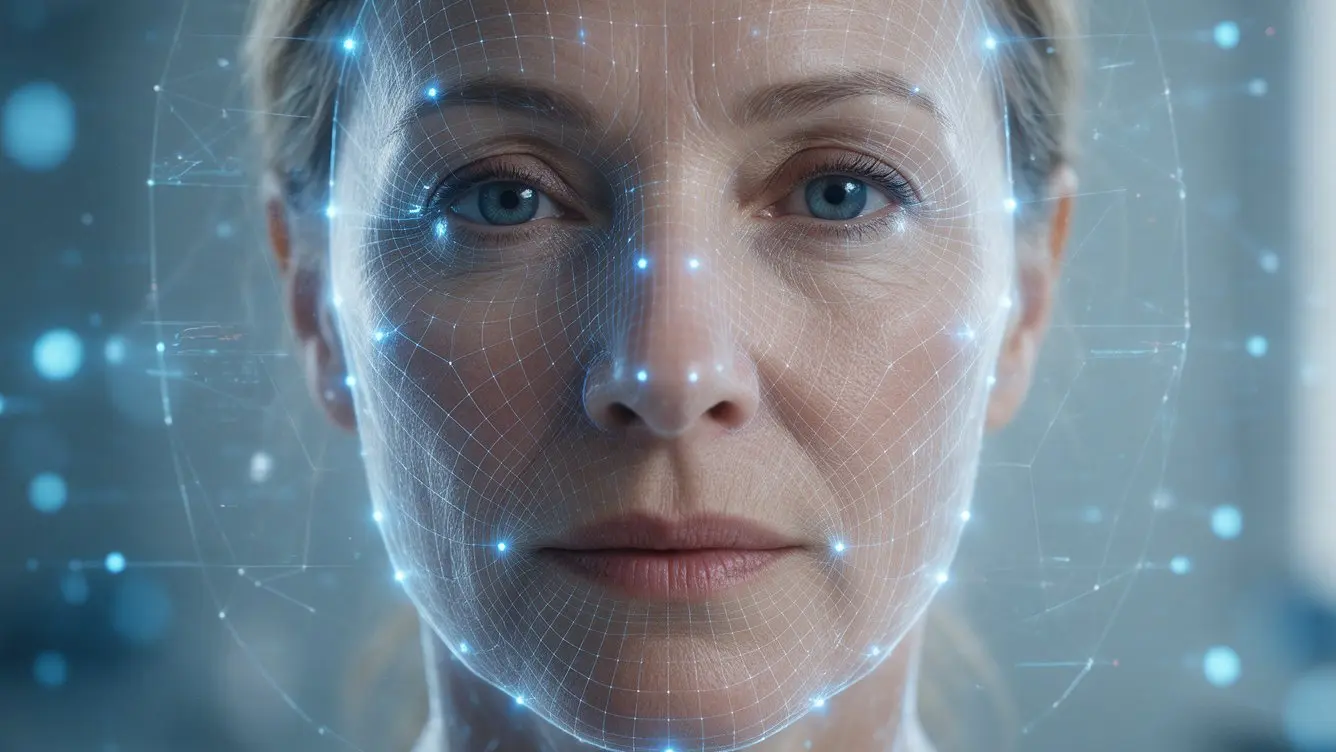
Just how large these differences are is illustrated by an analysis involving 3,820 cancer patients. Of these, FAHR-FaceSurvival assigned 122 to the highest-risk group. Of those patients, 64 — 52.5 percent — died within three months of the photo being taken. In the lowest-risk group, which included 975 patients, the figure was only around two percent.
Estimated facial age also proved meaningful. Among roughly 38,000 patients from Boston, those who looked at least five years older than their actual age had a 21 percent higher risk of death — even after accounting for age, sex, and type of cancer. For 1,060 patients, the AI estimated their age to be more than 20 years higher than it actually was; of these, roughly one in five died within 90 days.
One important caveat: the AI does not predict when any individual person will die. It identifies statistical differences between patient groups. The predictions were most accurate when the researchers combined both tools — which apparently capture different kinds of information.
Using so-called attention maps — a kind of heat map showing where an algorithm "looks" — the researchers were able to determine which facial areas matter most to the assessment. A clear difference emerged:
• For age, the AI focuses primarily on the wrinkles between the nose and the corners of the mouth, the forehead above the eyes, and the temples.
• For mortality risk, the area below the eyes and around the bridge of the nose comes to the fore.
Exactly what the AI perceives there, however, remains unclear. "We don't know exactly what these algorithms are looking at," Mak admitted to the Boston Globe. The maps show only where the algorithm looks — not whether it is registering bags under the eyes, wrinkles, age spots, or wasted muscle at the temples.
One possible explanation is the loss of muscle and fatty tissue. In serious illness, body composition often changes, and this can become visible in the face. For now, however, this remains speculation.
The findings have a remarkable historical parallel. Around 2,400 years ago, the Greek physician Hippocrates described the face of a dying person: a pointed nose, hollow eyes, sunken temples. In medicine, this image is still known today as the "facies hippocratica."
Some of these same facial regions now play an important role for the modern AI — even though it could not have known anything about Hippocrates. It was trained exclusively on photos and information about how old a person was and whether they had died. Discovering this echo across millennia within its own algorithms was "very eerie," Mak told CNN.
Whether the AI is actually capturing the same physical changes that Hippocrates described has not, however, been proven.
The researchers also examined which lifestyle habits are associated with an older-looking face. According to the press release from Mass General Brigham, heavy alcohol consumption, drug use, and smoking were each associated with an older appearance. The pattern was clearest for smoking: current smokers appeared older than former smokers — who in turn appeared older than people who had never smoked.
The system proved surprisingly robust against external factors. Head position, lighting, facial expression, and makeup had little effect on the assessment, as did most cosmetic surgeries. The one exception was rhinoplasty, after which the AI estimated facial age to be somewhat higher on average. The system apparently focuses on different features than the human eye does.
That said, facial age is not a direct measure of the biological aging of cells or organs.
In older cancer patients especially, date of birth often says very little. Two people of the same age can differ enormously in their physical resilience. One may tolerate intensive chemotherapy or surgery well, while for another it may simply be too much. Yet older cancer patients rarely receive a thorough assessment of their resilience — it usually comes down to a judgment call.
This is where the AI is intended to step in. The goal, Mak explains, is to make the assessment based on facial photos more measurable and consistent — as a support for personalized treatment decisions, not a replacement for medical judgment.
Whether this works in everyday clinical practice is currently being examined in two studies. In the first, the researchers are investigating in 60 patients aged 65 and over with early-stage lung cancer whether the AI can identify, before radiation therapy, those patients who need additional support such as nutritional counseling or physiotherapy. In the second, thoracic surgeons are combining facial analysis with data from wearables to estimate the risk of complications after major surgery.
Since spring, anyone interested has been able to upload their own photo to a research portal of Brigham and Women's Hospital. After giving consent and completing a short questionnaire — covering topics such as sleep and physical activity — FaceAge estimates biological age within seconds. According to the Boston Globe, more than 10,000 people have already taken part. The researchers plan to use the data to investigate which habits and conditions are associated with a younger or older appearance.
There are two things interested participants should know: the portal is for research purposes, not diagnosis — no mortality risk assessment is provided there. In addition, facial photos and, if desired, health information are transmitted to a US research project. Anyone wishing to participate should therefore read the consent form carefully.
Despite the impressive results, the study has important limitations:
• It is based on existing patient data. The predictions were assessed retrospectively, not in a clinical trial.
• Predictive power varied depending on cancer type. Pathologist Pratik Shah from the University of California, Irvine, who was not involved in the study, notes that facial age showed a significant association with survival in only 18 of 28 cancer types.
• The patients came from clinics in Boston and Maastricht. How reliably the method performs in other population groups and in healthy individuals remains unclear.
• The AI may primarily be detecting the visible consequences of an already advanced disease — rather than novel, previously unrecognized health markers.
Ethical questions also arise. Facial photos are easy to obtain — and it is not hard to imagine that insurers or employers might one day take an interest in such health predictions. Aerts had already acknowledged with the predecessor model that the technology could cause harm if misused.
FAHR-Face is therefore not an established diagnostic tool. And an ordinary selfie certainly cannot be used to determine how long a healthy person will live.
The idea that a photo might contain clues about our health future initially seems almost uncanny. But the study's deeper insight is a different one: our faces apparently hold more medically useful information than the naked eye can reliably capture. Whether this will become a tool that helps cancer patients receive better-tailored treatment is something the ongoing studies have yet to show.

Implant or your own tissue, now or after treatment — or perhaps no reconstruction at all? Plastic surgeon Dr. Juliane Bodo explains what role radiation plays, what risks to expect, and why no one should make this decision under pressure.
Christine Bürg & Marianne Waldenfels

An interview with
Dr. med. Juliane Bodo

A single hydrogel injection into the knee may relieve osteoarthritis pain for years. Orthopedist Dr. Ivo Breitenbacher has treated around 200 patients with it and explains who the procedure is right for and where its limitations lie
Christine Bürg & Marianne Waldenfels

An interview with
Dr. med. Ivo Breitenbacher

Almost everyone has seen them, and most people ignore them: tiny specks and strands drifting across their vision. Usually, they’re harmless. But sometimes they signal an emergency where quick action can save your sight. Ophthalmologist Dr. Mirka Höltzermann explains which warning signs to watch for.
Christine Bürg & Marianne Waldenfels

An interview with
Dr. Mirka R. Höltzermann