© Magnific
May 27, 2026
Christine Bürg & Marianne Waldenfels
From LASIK to SMILE, ophthalmologist Dr. Tabitha Neuhann explains today’s most advanced laser eye treatments, potential side effects and long-term results.

An interview with
Dr. med. Tabitha Neuhann
Whoever thinks about eye laser surgery often has many questions and often also respect for the procedure. How safe is lasering? Who is the treatment suitable for? What risks are there? And does the result actually last permanently?
Dr. Tabitha Neuhann, together with her father Tobias Neuhann and her brother Raphael, leads the Ophthalmologikum Dr. Neuhann. One of her specialties: modern laser therapies for the correction of visual impairments.
In the conversation, the specialist explains why contact lenses are often underestimated, which laser procedures are state of the art today, and why she decided to have her own eyes lasered.
This is actually not so easy to answer in general, because you are comparing two completely different things: contact lenses on one side and a surgical procedure on the other.
Contact lenses initially seem less harmful because they are everyday items and you can decide when to wear or remove them. But therein lies a problem: Hygiene is entirely dependent on the patient. And poor contact lens hygiene can cause severe corneal infections.
I myself wore contact lenses for years – and definitely wasn’t an exemplary patient. Worn them too long, sometimes slept in them – so I know the disadvantages very well. Especially in the long term, contact lenses can change the cornea.
However, laser surgery is a procedure – that must be made clear. But in the long term, I consider it the safer and often more cost-effective solution.
Yes, absolutely. Patients come to us today incredibly well-informed. Many have already dealt intensively with the subject, know the pros and cons, and have often already decided internally.
In the past, you had to explain a lot more and do more persuasion work. Today, it’s more of a joint conversation at eye level. This is, of course, also because eye laser surgery is now much more widespread, and many know someone in their circle who has already undergone laser surgery.
Matcha vs. Oolong: Which tea is healthier, provides more energy — and what does the research say?
Marianne Waldenfels
Basically, there are three classical visual impairments that we treat: The most common is nearsightedness. Affected individuals see blurry in the distance, but can usually read up close without any problems. Then there is farsightedness – which is exactly the opposite: Distance vision works well, but reading or close work becomes difficult.
And finally, astigmatism, medically called astigmatism. The cornea is not evenly shaped everywhere. Dots or lines appear distorted or elongated. We treat nearsightedness and astigmatism very frequently with the laser.
It is usually a mix of practical, emotional, and sometimes aesthetic reasons. In the past, aesthetics probably played a larger role. Today, many people even like wearing glasses. The most common reason is more about the limitations in everyday life.
Many say: "I want to be free when doing sports." Or no longer wear fogged glasses under ski goggles while skiing. Others are annoyed by traveling with contact lens containers, solutions, and spare glasses.
Another common reason is contact lens intolerance. Many develop dry eyes and can eventually only wear their lenses for a few hours. And then there are professional reasons – such as in the police or military.
Yes, when lasered. The treatment takes only about 20 to 30 minutes for both eyes. The actual laser time is often only a few seconds per eye. Most of it is actually preparation. In other procedures – such as when lenses are implanted – the eyes are operated on at different times.
We recommend our patients take a few days off. That's why we consciously plan many procedures towards the weekend.
Important to know: Laser eye surgery is considered a cosmetic procedure and not a medically necessary operation. Therefore, there is usually no sick leave for it. Most people see significantly better than before without glasses on the first day. After a few days, many are able to work again.
Not forever – but very long. Almost everyone experiences the so-called presbyopia eventually, usually from their mid-40s. This also affects people without previous visual impairment.
However, this does not mean that the laser treatment has "failed." The original problem – such as nearsightedness – is still corrected. In principle, one can undergo additional laser treatment, but this always depends on the individual case.
As with any procedure, there are risks with laser treatment. However, it is important to note that the general complication rate is below one percent worldwide. Most commonly, we see dry eyes. When lasering, we change the cornea – where there are many nerves that, among other things, control the blink reflex. As a result, the eye can temporarily become drier.
Therefore, we work intensively with moisturizing drops. Usually, this significantly improves within a few days or weeks.
Some patients notice so-called halos around light sources at night – similar to a halo effect. This is something particularly highly nearsighted individuals often already know. Generally, one gets used to it. Of course, under- or overcorrections can also occur. Every person heals differently, and despite the most modern technology, the eye remains a biological system.
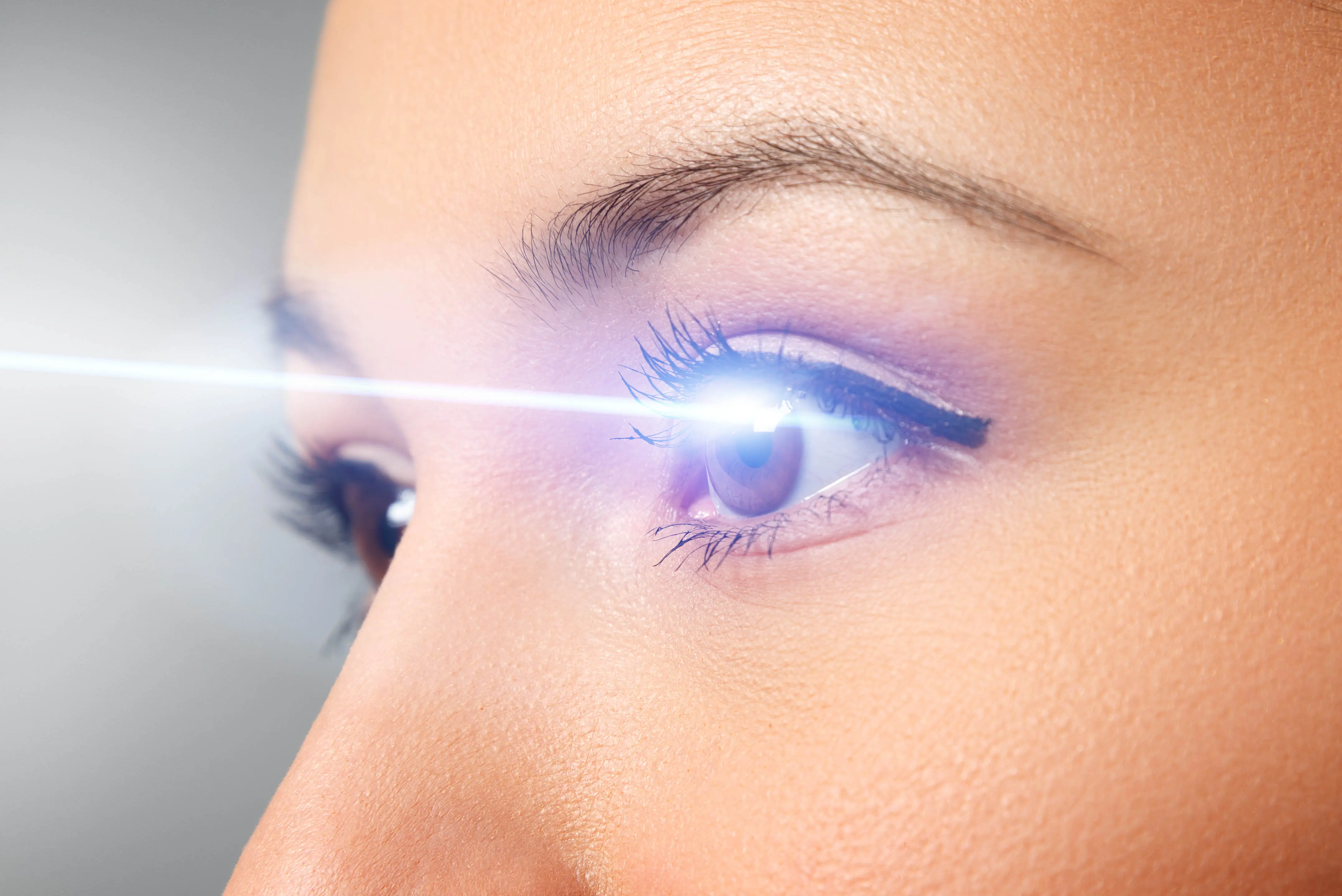
The most common procedure with us currently is the so-called Femto-LASIK. Here, we work with two lasers: First, a thin corneal flap is prepared, then a second laser reshapes the cornea.
The most advanced procedure currently is the so-called SMILE method. Here, a small piece of tissue within the cornea is removed without creating a classic flap. In addition, there is the so-called Trans-PRK or No-Touch technique. No instrument touches the eye here – the laser works completely contactlessly.
The results are very good for all procedures. Differences mainly exist in the healing process and in determining which procedure is best suited for each patient.
The statutory health insurance does not usually cover the costs as it is considered a cosmetic procedure. For private health insurance, it depends heavily on the plan. Some may partially cover the costs.
Depending on the procedure, the total costs for both eyes usually range from about 4,600 to 5,500 euros.
Yes. One of the most common reasons is a cornea that is too thin. During laser surgery, tissue is removed – for this, a certain remaining thickness is needed. Also, the vision must be stable. If the values are constantly changing, laser surgery makes little sense.
Very high refractive errors can also be problematic. However, there are often alternatives here – such as implantable contact lenses, so-called ICL lenses. And, of course, we need a healthy eye. Inflammatory diseases or certain autoimmune diseases can speak against a procedure.
During pregnancy and breastfeeding, we generally don't perform laser treatments because hormonal changes can affect the cornea.
During the laser treatment itself, patients usually don't feel any pain because we numb the eyes with drops. Afterward, however, it can be uncomfortable for a few hours: burning, scratching, watery eyes, and light sensitivity are typical.
Many patients briefly think on the day of the surgery, "Why did I do this?" – but usually, the world looks quite different the next morning. You notice something was done, but you're not really sick. Many go for walks, have meals with friends, or even travel just a few days later.
I myself flew the day after my treatment – much to my father's dismay. But everything went well.