Creatine Gummies and Blends: Big Promises, Little Substance?
Creatine now comes in gummies, collagen blends, and electrolyte drinks. These products promise more benefits in one convenient formula. But new studies and lab tests raise questions about whether they're worth the extra cost. Some gummies contain barely any creatine at all.
Five grams of creatine is what a daily serving of gummy candy is supposed to deliver. But when American testers examined the product in a lab, they found just 0.005 grams — less than one thousandth of the promised amount. It was not an isolated case: in a 2025 investigation by the US platform SuppCo, four out of six creatine gummies tested failed. The five powders also examined, by contrast, all passed.
Creatine has become one of the most sought-after dietary supplements, and not just in strength sports. Manufacturers are increasingly turning to new delivery formats and blends: gummy candies, collagen powder with creatine, and electrolyte drinks that promise multiple health benefits at once. But not everything that sounds convenient is actually useful.
What these new creatine products actually deliver — and whether the higher price is worth it — is what current studies and lab tests reveal.
What Creatine Can Do for Muscles and the Brain
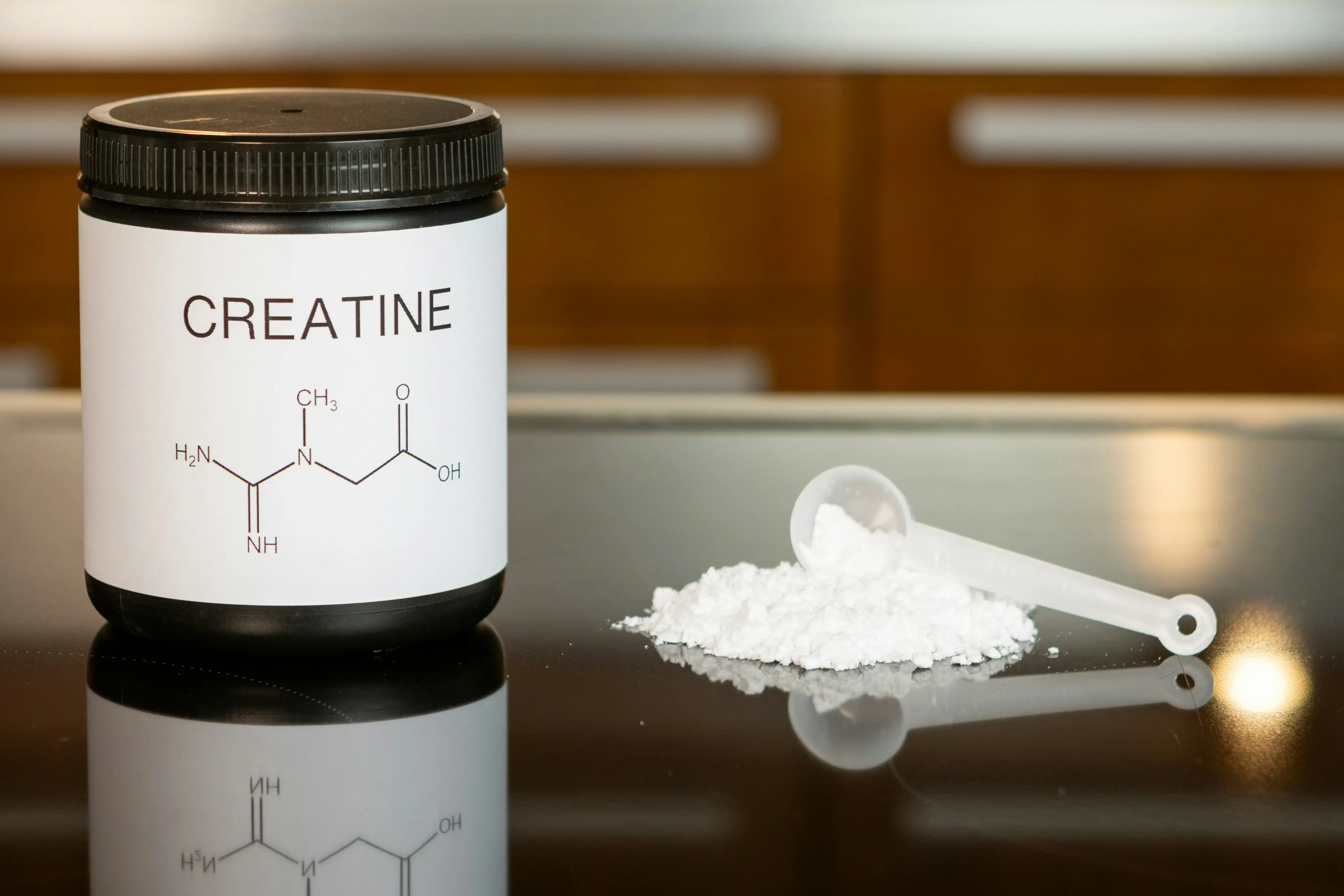
Creatine helps muscles rapidly generate energy during short, intense bursts of exertion. People who train with weights regularly can use it to boost performance and build greater muscle strength. This has been well studied for decades. A position paper from the International Society of Sports Nutrition (ISSN) confirms the effect. Creatine monohydrate is the best-researched form. More expensive variants such as creatine HCl or creatine malate have not demonstrated any additional benefit so far.
Research has now also turned its attention to the brain. A meta-analysis of 16 clinical studies involving 492 participants found indications that creatine can improve memory. Studies conducted under conditions of sleep deprivation are particularly interesting: in a 2024 study, participants who received a high dose of creatine performed better on certain cognitive tasks despite sleep deprivation compared to those on placebo. However, the European Food Safety Authority (EFSA) considers the existing evidence insufficient to support a corresponding health claim.
It is precisely this prospect of additional effects that makes creatine appealing beyond strength sports. Whether combinations with collagen, electrolytes, or other additives actually deliver more is, however, a different question.
Creatine with Collagen: New Study Finds No Clear Added Benefit
Two popular dietary supplements in one product: creatine and collagen are increasingly being sold together. The combination is intended to support not only muscles but also skin and joints. Researchers have now investigated whether it at least aids recovery after exercise more effectively than creatine alone.
Scientists at South Korea's Seowon University explored this question in a randomized, placebo-controlled study published in October 2026 in the journal Applied Sciences. They examined 30 untrained adults between the ages of 19 and 29, who received either creatine, creatine with collagen, or a placebo. After one week of supplementation, participants completed an intensive muscle training session. Over the following four days, the researchers measured muscle strength, flexibility, muscle soreness, and swelling, among other things.
The result: the combination did not perform convincingly better than creatine alone. While differences in muscle strength were initially observed, these were no longer clear-cut after more rigorous statistical analysis.
Whether creatine and collagen taken together over a longer period offer benefits for skin or joints was not examined in the study. For muscle recovery after training, at least, no clear added benefit was found.
Those who already take both supplements can certainly combine them. Based on current findings, however, they should not expect any special training effect from doing so.
Creatine with Electrolytes: Unnecessary for Most Athletes
Also popular are electrolyte drinks containing creatine. These combine the active ingredient with minerals such as sodium, potassium, or magnesium, which play an important role in fluid balance and muscle function, among other things.
For long, sweat-intensive training sessions, replenishing fluids and electrolytes can be beneficial. Those who train only moderately and eat a balanced diet generally do not need additional electrolytes.
Above all, there is no convincing evidence that creatine combined with electrolytes improves muscle strength more than creatine alone. For most recreational athletes, such a combo product is therefore mainly a matter of convenience.
Creatine with L-Carnitine: Lots of Marketing, Little Extra Benefit
L-carnitine is frequently marketed as a aid for fat burning. Combined with creatine, it is supposed to promote muscle building and weight management at the same time.
The evidence on supplementing with L-carnitine in healthy individuals is, however, mixed. In particular, the available data do not support the conclusion that combining it with creatine reliably improves muscle building or fat burning.
Those who want to take creatine to support strength training do not need additional L-carnitine for that purpose.
Creatine with Protein, Carbohydrates, or Caffeine
The picture looks somewhat different for combinations with protein or carbohydrates. Research shows that these can improve creatine uptake into the muscles under certain conditions. Whether this translates into greater performance gains than creatine alone, however, is not clearly established. The ISSN position paper also notes this.
Pre-workout products frequently contain both creatine and caffeine. The two substances work in different ways: caffeine can increase alertness and training performance in the short term, while creatine works by gradually replenishing muscle stores.
No special mutual enhancement between the two has been established. Indications that caffeine might weaken the effects of creatine are also not yet conclusive.
Creatine Gummies: Why the Active Ingredient Can Disappear
While most creatine blends raise questions about missing added benefit, gummies present a more fundamental problem: do they actually contain the promised amount of creatine?
Creatine is relatively stable in dry powder form. In the presence of water, however, it can break down into creatinine over time. Heat and an acidic environment accelerate this process — and these are precisely the kinds of conditions that can occur during the manufacturing and storage of gummy candies.
As early as 2024, American supplement manufacturer NOW Foods had various creatine gummies tested in a laboratory. In half of the products tested, the creatine content fell below the stated amount.
A year later, lab tests by the US platform SuppCo reached a similar conclusion: while all creatine powders examined passed the tests, several gummies contained significantly less active ingredient than promised. That said, some products did meet their stated quantities.
These results come from the US market and cannot be directly applied to German brands. Furthermore, only selected products and batches were tested. They do, however, illustrate how important manufacturing quality and ingredient stability are.
The Key Number: Three Grams of Creatine Per Day
Whether powder, gummy candy, or combo drink — what matters above all else is the dosage. Three grams of creatine per day is considered a scientifically well-supported amount for a performance-enhancing effect and also forms the basis of the corresponding EU health claim. It is important to distinguish between creatine and creatine monohydrate.
Three grams of creatine monohydrate do not contain three grams of pure creatine. According to the German Consumer Advice Centre, approximately 3.41 grams of creatine monohydrate are needed to supply three grams of creatine.
Accurate labeling is therefore important for combo products. Some manufacturers state the total quantity of an entire blend without clearly indicating the creatine content. With gummies, the daily serving is often spread across multiple pieces.
Creatine also does not work like an energy drink immediately after consumption. It replenishes creatine stores in the muscles gradually over a longer period of time. According to the ISSN position paper, stores can be gradually replenished with three to five grams of creatine monohydrate daily over approximately three to four weeks. Regular daily intake is therefore advisable, rather than using it only on training days.
What Consumers Should Look for When Buying
When buying creatine, the main things to look for are the exact dosage, the form of creatine used, and transparent labeling.
The packaging should list creatine monohydrate as the form. Additional ingredients only make sense if they serve a clear and comprehensible purpose of their own.
For gummies, up-to-date lab analyses are especially important. These should explicitly state the creatine content of the finished product and ideally also account for stability during storage.
For healthy adults, creatine monohydrate in typical amounts is considered well tolerated. People with kidney disease or other relevant pre-existing conditions should consult a doctor before use. The same applies to pregnant and breastfeeding women, as well as children and adolescents.
Conclusion: More Ingredients Don't Mean More Effect
Creatine combined with collagen, electrolytes, or L-carnitine can be convenient if you already want to take those additional substances. However, existing studies do not convincingly demonstrate any special benefit of the combination over creatine alone.
Creatine gummies present an additional problem: American lab tests show that some products contain significantly less creatine than stated. Others pass the tests — so the quality of the individual product is what matters.
Those who primarily want to support their muscle strength and training performance are usually better served by pure creatine monohydrate. It is the most thoroughly studied form, can be reliably dosed, and costs significantly less than most combo products.