© Harri Hofer
September 16, 2026
Marianne Waldenfels
Granny Smith, Gala, Braeburn, or Boskoop? Apples vary more in their plant compounds than most people realize. Studies show which varieties contain the most polyphenols — and why traditional varieties such as Boskoop perform surprisingly well.
Granny Smith is tart and crunchy, Gala is on the sweeter side, and Boskoop often ends up in apple cake. Yet when it comes to health, we tend to treat all apples as more or less the same. An apple is an apple.
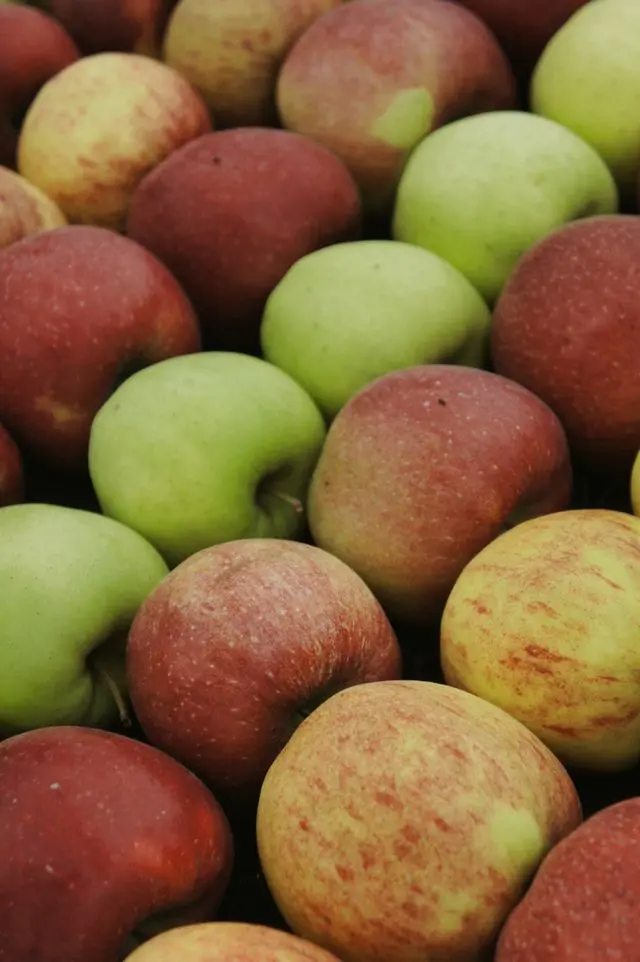
But the variety really does matter. Apples can contain vastly different amounts of polyphenols — plant compounds that researchers are studying for their antioxidant and anti-inflammatory properties, among other benefits. And when common varieties are put head to head, one apple consistently comes out on top: Boskoop.
A revealing comparison comes from a German study that pitted ten traditional apple varieties against five widely available ones. The traditional group included Red Boskoop, Berlepsch, Golden Reinette, and Gravenstein. The comparison group consisted of Braeburn, Elstar, Golden Delicious, Granny Smith, and Jonagold.
This is not simply a question of old versus new apples. Golden Delicious, for instance, has been around for more than a century. What distinguishes the traditional varieties is their roots in historical fruit cultivation and their relative scarcity compared with the apples typically found in supermarkets and commercial orchards.
The difference in polyphenol content was striking: the flesh of the traditional varieties contained an average of 29 milligrams per 100 grams, compared with just 13 milligrams in the five widely available varieties — less than half as much.
Red Boskoop and Dülmener Rosenapfel stood out in particular, ranking among the top varieties for polyphenol content in the flesh. Golden Delicious, by contrast, placed near the bottom for both skin and flesh.
Boskoop also stands out in other research. An analysis of seven varieties available on the German market found around 90 milligrams of polyphenols per 100 grams in the whole cored Boskoop. Braeburn came in at 41 milligrams. Even higher values were recorded for Golden Reinette at 123 milligrams and Gewürzluiken at 158 milligrams.
Boskoop is therefore not the most polyphenol-rich apple of all. However, among the varieties that are relatively easy to find, it ranks among those with particularly high levels.
The strong showing of traditional varieties may have to do with how they were bred. Polyphenols also influence characteristics that are not always welcome in a modern eating apple: they can contribute to an astringent, slightly tart flavor and play a role in the browning of cut fruit.
When many of today's common varieties were developed, breeders often prioritized other traits — sweetness, appearance, shelf life, or minimal browning. The authors of the German study point to this as a likely explanation for why some traditional varieties have higher polyphenol content.
That said, not every traditional apple automatically comes out ahead. Even within the groups studied, there were wide differences. The specific variety is still the deciding factor.
Even within a single apple, plant compounds are not evenly distributed. Many polyphenols are found in especially high concentrations in the skin.
In the analysis of varieties available on the German market, polyphenol levels in the skin ranged from 68 to 285 milligrams per 100 grams depending on the variety. In the flesh, the range was 17 to 127 milligrams.
Because the skin makes up only a small portion of the whole apple, it does not necessarily account for the majority of total polyphenols. Even so, eating a well-washed apple unpeeled is worthwhile.
What about color? It is less useful as a guide than you might think. Red apple skins contain anthocyanins, which give them their color. However, other polyphenols are found in equal measure in green and yellow apples. A red apple is not automatically healthier than a green one.
Differences in polyphenol content between varieties are easy to measure. But do apples with particularly high levels of polyphenols actually offer greater health benefits?
There are early signs that they do. A systematic review published in 2026 analyzed 38 human studies on apples and apple products. It found positive effects on blood sugar and vascular function, as well as on the gut microbiome. However, the studies varied widely in design, so it is not yet possible to say definitively which compounds are responsible.
That an apple's composition could genuinely make a difference is suggested by a small study involving 25 healthy adults. Researchers compared a particularly polyphenol-rich red-fleshed apple with a white-fleshed apple. After eating the red-fleshed apple, participants showed higher levels of gut bacteria associated with a healthy gut microbiome. Certain immune system genes also responded differently compared with after consumption of the white-fleshed apple.
These findings offer early indications that different polyphenol levels in apples also have measurable effects in the body. Whether this translates into long-term health benefits cannot yet be concluded from such a small study.
Among the varieties commonly available, Boskoop is the best choice. It contains particularly high levels of polyphenols and consistently outperforms popular supermarket apples such as Braeburn or Golden Delicious in studies.
Eating it with the skin on means absorbing an especially large amount of these health-relevant plant compounds.

"Feel Good, Live Better" – in this podcast episode, Dr. Gesche Brannolte-Raab shares what each of us can do to reduce our risk of developing cancer.
Christine Bürg

An interview with
Dr. med. Gesche Brannolte-Raab

Deadline pressure, constant availability, little time to recover: stress is often unavoidable in everyday life. But when does it actually become a risk to the heart? Cardiologist Prof. Dr. Uwe Nixdorff explains why recovery is crucial — and how chronic stress can even be measured.
Christine Bürg & Marianne Waldenfels

An interview with
Prof. Dr. Uwe Nixdorff

Collagen is frequently recommended for joint pain – often with the promise that it can strengthen or even rebuild cartilage. A large scientific review now paints a more nuanced picture. Orthopedic surgeon PD Dr. Daniel Berthold explains who may benefit from collagen – and what these supplements cannot do.
Christine Bürg & Marianne Waldenfels

With
PD Dr. med. Daniel P. Berthold