© Magnific
November 5, 2026
Marianne Waldenfels
Replacing even some cow's milk, yogurt, and cheese with plant-based alternatives can significantly reduce the intake of an essential nutrient, according to a new British study. Young women are particularly affected. Here's why the findings matter in Germany, too, and what to look for when shopping.
A splash of oat milk in a cappuccino, almond milk in muesli, soy yogurt for breakfast: plant-based milk alternatives have long since become part of everyday life. Many people choose them for environmental or animal welfare reasons, others because of lactose intolerance, or simply because they prefer the taste. But as similar as these products may look on the shelf, when it comes to nutrients they are often not an equivalent substitute. A new study shows that one mineral in particular falls short — one that hardly anyone thinks about: iodine.
Researchers at the University of Surrey and Queen's University Belfast calculated what happens when milk, yogurt, and cheese are partially or fully replaced by plant-based alternatives. Their analysis drew on dietary data from more than 3,500 people aged 18 months to 100 years. The results were published in early November 2026 in The Lancet Planetary Health .
The researchers examined a range of scenarios, from replacing 20 to 35 percent of dairy products all the way to eliminating them entirely. They focused on four nutrients for which dairy is an important source: iodine, calcium, vitamin B2, and vitamin B12.
The difference was most pronounced for iodine. Even with a partial replacement, the estimated share of people with inadequate iodine intake rose considerably:
With a complete switch, that share climbed as high as 80 percent among teenage girls and 72 percent among boys of the same age.
These are not measured iodine deficiency values, but model calculations based on dietary data. An intake below recommended levels does not automatically mean a deficiency already exists. Nevertheless, the results clearly show how significantly replacing dairy products can affect iodine intake.
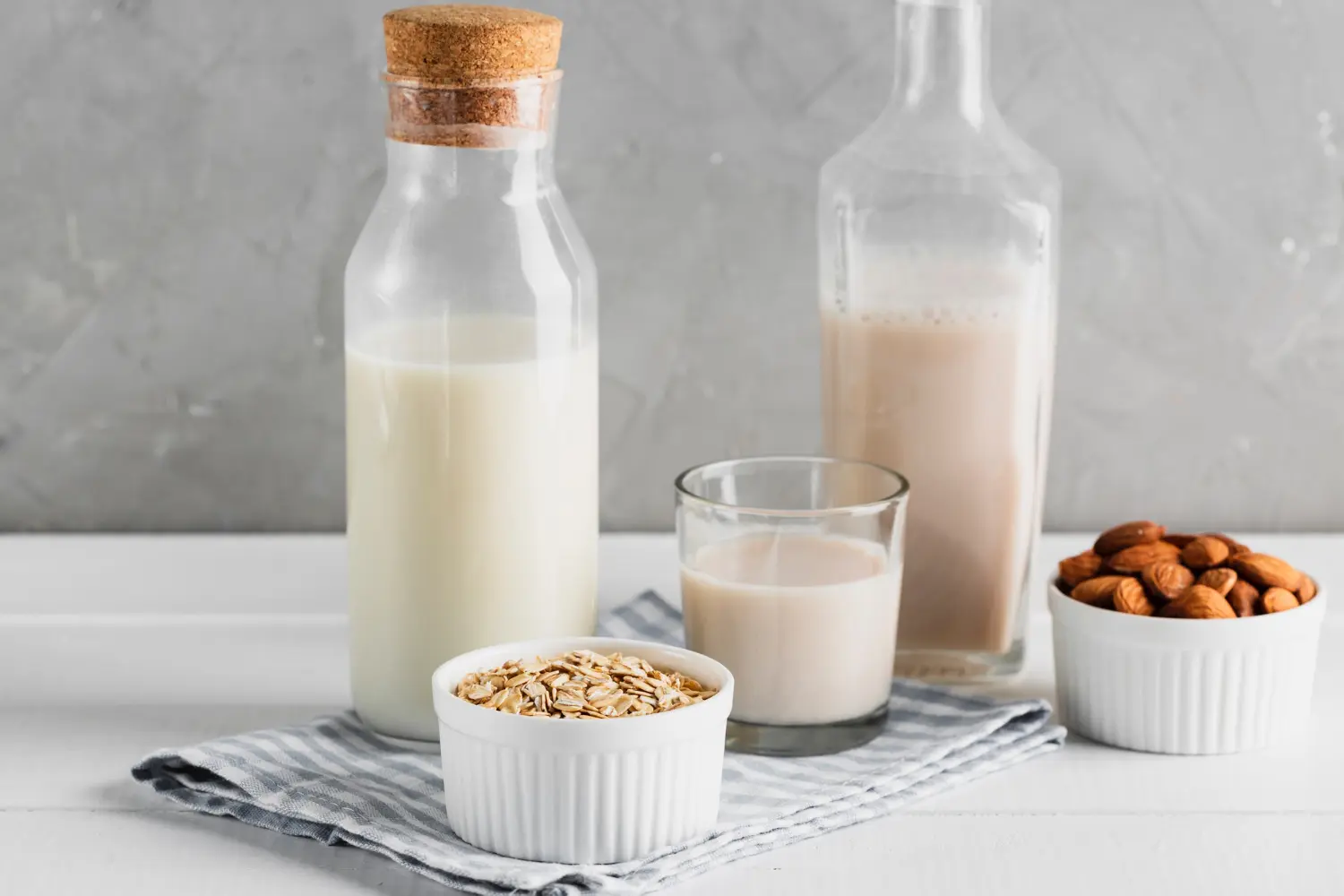
Cow's milk contains iodine primarily because it is added to cattle feed. Oats, almonds, and rice naturally provide very little of it. If plant-based drinks are not specifically fortified, they therefore lack a nutrient that cow's milk normally supplies.
In Germany, milk and dairy products are among the most important dietary sources of iodine. According to the Federal Institute for Risk Assessment (BfR) , one liter of cow's milk provides approximately 100 to 150 micrograms of iodine. Organic milk typically contains somewhat less.
The body needs iodine to produce thyroid hormones, which regulate metabolism, among other functions, and are essential for growth and brain development. The German Nutrition Society recommends 150 micrograms of iodine per day for adults, 220 micrograms for pregnant women, and 230 micrograms for breastfeeding women.
The British findings cannot be applied directly to Germany. In the United Kingdom, iodized table salt is rarely used, whereas in Germany it is at least widely available in retail stores. Even so, iodine supply in Germany has also deteriorated in recent years.
According to the BfR, iodine supply in Germany is still not optimal. Through foods that do not contain iodized salt, adults take in an average of only about 75 micrograms of iodine per day — roughly half the recommended amount.
Compounding this, food manufacturers are increasingly forgoing iodized salt. According to data from the Max Rubner Institute, the share of bread and bread rolls made with iodized salt fell from 13 to nine percent between 2020 and 2025. For processed meats, it dropped from 48 to 34 percent over the same period.
The situation is especially concerning for younger women. According to data from the DEGS study by the Robert Koch Institute, around 47 percent of women aged 18 to 29 and nearly 40 percent of those aged 30 to 39 face a significantly elevated risk of iodine deficiency.
Those who already have a low iodine intake and then also replace dairy products with non-fortified plant-based drinks lose yet another important source of the mineral.
The organic label indicates that certain production and processing standards have been met — but it says little about the content of vitamins and minerals. For plant-based milk alternatives, it can actually be a disadvantage.
Many conventional manufacturers now enrich their drinks with calcium and vitamins. A survey by the consumer advice center from early 2026 found that 87 percent of the conventional products examined were fortified with calcium, and 71 percent with vitamin B12. Iodine, by contrast, is added far less frequently.
For organic products, such additions are fundamentally restricted. Under the EU Organic Regulation, isolated vitamins and minerals may generally not be used for fortification. In the consumer advice center's sample, only six percent of organic drinks contained added calcium; other nutrients were not added at all.
A ruling by the European Court of Justice from late October 2026 could change this, at least with regard to calcium: organic plant-based drinks may now be fortified with lime derived from the red alga Lithothamnium calcareum . However, this does nothing to close the gap in iodine supply.
With organic oat and almond milk in particular, it is therefore worth reading the ingredient list carefully. What is considered especially natural in terms of production is not automatically the more nutrient-rich choice.
The British researchers also modeled what impact the targeted fortification of plant-based milk alternatives would have. While this would prevent many of the nutrient losses, a considerable iodine gap remained even then.
Among teenage girls, the proportion with inadequate iodine intake still stood at 59 percent even when fortified plant-based drinks were used. Only when the researchers additionally factored in iodized bread did that figure drop to 37 percent.
The study authors therefore advocate a combined approach: plant-based milk alternatives should be fortified with key nutrients, and iodized salt should be used more widely in food production.
The BfR also recommends targeted iodine fortification of milk substitute products. In its maximum level proposals , the institute suggests 14 micrograms of iodine per 100 milliliters — roughly the same amount found in cow's milk.
Anyone buying oat or almond milk should check the ingredient list. Some manufacturers add calcium and vitamin B12, bringing these nutrients closer to the levels found in cow's milk. Iodine, however, is still rarely included.
The rest of the diet matters too. Iodized table salt and sea fish can both contribute to iodine intake. Dried seaweed, on the other hand, should be treated with caution: its iodine content varies widely and can be extremely high.
Adequate iodine intake is especially important during pregnancy and breastfeeding. The BfR therefore generally recommends, after consulting a doctor, taking an additional iodine supplement of 100 micrograms per day.

A Hamburg orthopedic surgeon harvests tiny cartilage samples from the ear and injects them into arthritic knees. In this interview, Dr. Hans Olaf Baack explains who may benefit, what early studies show and why he avoids making promises
Christine Bürg & Marianne Waldenfels
An interview with
Dr. med. Hans Olaf Baack

Burning or watery eyes despite regular use of eye drops? Ophthalmologist Dr. Christine Heun explains what causes the symptoms, why women are more frequently affected, and which new treatments are available.
Christine Bürg & Marianne Waldenfels

An interview with
Dr. Christine Heun

When fingers tingle or go numb at night, carpal tunnel syndrome may be to blame. Hand surgeon Prof. Dr. Helen Abel explains when a splint is sufficient, why waiting too long can cause permanent nerve damage, and what the chances of recovery are after surgery.
Christine Bürg & Marianne Waldenfels

An interview with
Prof. Dr. med. Helen Abel