© Magnific
September 13, 2026
Marianne Waldenfels
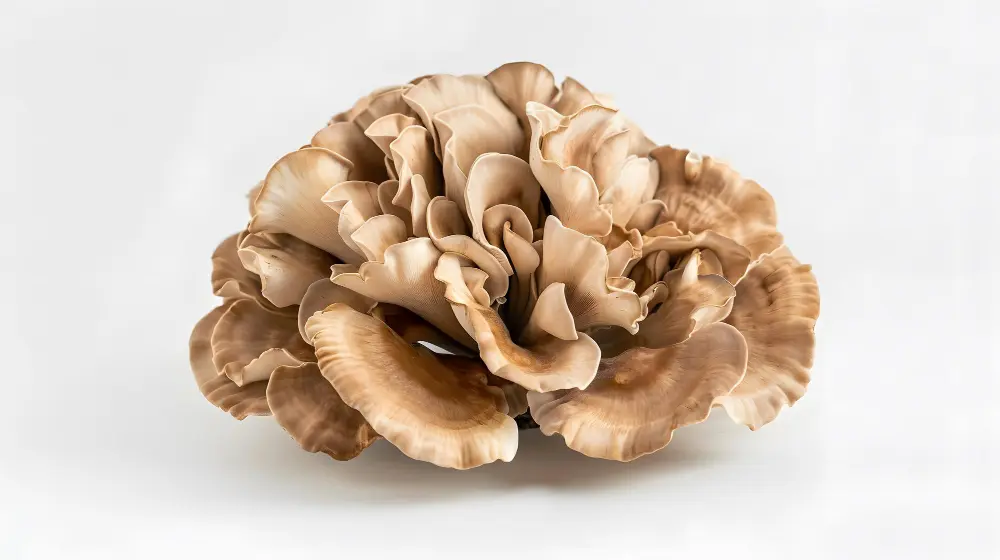
Maitake is best known as an edible mushroom, but it is becoming increasingly popular for its potential health benefits. Now, two new human studies offer surprising clues about its effects on the brain and immune system – but not all maitake appears to work the same way.
Reishi stands for relaxation, lion's mane for concentration, and chaga is the new darling of the longevity scene. Medicinal mushrooms have long since made the leap from traditional Asian cuisine into powders, capsules, and wellness drinks. Now another mushroom is coming into sharper focus: maitake.
In Japan, the mushroom – also known as hen of the woods – has been eaten for a long time. Of particular interest to researchers are its beta-glucans: complex carbohydrates that can interact with the immune system. As is so often the case with medicinal mushrooms, the hype has far outpaced the clinical evidence. Many of the supposed effects have emerged from laboratory studies, animal experiments, or small-scale trials.
Now there is new data. In 2026, two randomized, double-blind, placebo-controlled human studies were published: one on cognitive abilities and one on the immune system. What is remarkable is not only that maitake showed an effect – but which maitake did.
For the first study published in 2026, researchers examined 47 healthy Japanese men and women aged 60 and older. For 18 weeks, they received daily bread made with either maitake of strain Y10M, maitake of strain C5304, or no maitake at all. In each case, the amount used corresponded to 50 grams of fresh mushroom.
Before and after the intervention, participants completed a number of tests, including the Montreal Cognitive Assessment, or MoCA. The test evaluates abilities such as attention, memory, language, and orientation, and is frequently used to detect early signs of mild cognitive impairment.
After 18 weeks, the Y10M group performed better than the placebo group. No such difference was observed with the second maitake strain, C5304.
At first glance, this sounds like a minor sensation: an edible mushroom that could improve cognitive performance. However, the research has not quite reached that conclusion. A sample of 47 participants is small, and 18 weeks is a short timeframe. Moreover, the study looked at healthy older adults, not people with or already-diagnosed cognitive impairments.
The study therefore does not show that maitake protects against dementia. It offers an initial indication that a specific maitake strain might influence cognitive processes.
Alongside cognitive performance, the researchers also examined various immune system parameters and came across a striking correlation.
In the Y10M group, the activity of so-called natural killer cells increased. These cells are part of the innate immune defense and can recognize, among other things, virus-infected or abnormal cells in the body. Notably, the higher activity of these cells coincided with better MoCA scores.
Could the immune system, of all things, explain why the cognitive scores changed?
It is possible – but unproven. The researchers themselves discuss a connection between immune function and cognition, yet no causal relationship can be drawn from the observed correlation.
There is something else worth noting here: several of the authors work in the research and development department of Japanese mushroom producer Yukiguni Factory. This does not invalidate the study. However, when the body of evidence is still limited, independent replications of the results are especially important.
A second randomized double-blind study published in August 2026 examined the immune question in a more targeted way. This time, 166 healthy people in Japan took part. Again, maitake strains Y10M and C5304 were compared with a placebo.
The central question was refreshingly practical: do people who eat maitake get sick less often? The answer, so far, is no.
The frequency of upper respiratory tract infections did not differ overall between the groups. In other words, eating maitake did not fundamentally reduce the likelihood of catching a cold.
The study was not entirely without signals, however. In the Y10M group, both age groups examined experienced fewer days with fever and a runny nose. Among the younger participants, fewer days with a sore throat were also recorded. At the same time, various parameters of the innate immune defense showed changes.
And once again, the same maitake strain stood out: Y10M. C5304 showed considerably less consistent effects.
That may be the most interesting insight from the new research. When we talk about medicinal mushrooms, we usually think in terms of species: maitake is said to do this, reishi that, and lion's mane something else entirely. In reality, however, even different strains of the same mushroom species can vary considerably.
This is well established in other areas of nutrition. An apple is not simply an apple – variety, cultivation, and processing all influence its composition. With mushrooms, there is the added factor that the structure of their beta-glucans can also differ.
And apparently it is not just quantity that matters. Structure, branching, molecular size, and solubility can all influence how beta-glucans act in the body. Particularly noteworthy: in the new immune study, the two maitake strains contained comparable amounts of beta-glucans – yet their effects were not the same.
For dietary supplements, this is no minor detail. A product can say "maitake" on the label without necessarily containing the same mushroom that was examined in a study.
These studies also call into question another popular wellness promise: the idea that all you need to do is properly "boost" your immune system. The body simply does not work that way.
When certain immune markers change, that does not automatically mean we get sick less often. The current maitake study illustrates this almost textbook fashion: the researchers observed changes in the immune response and fewer days with individual cold symptoms, but not fewer respiratory infections overall.
That maitake apparently does not simply upregulate the immune system was already suggested by an earlier phase I/II study involving 34 women following breast cancer treatment. Depending on the dose, some of the immune parameters examined were enhanced while others were reduced.
After all, a healthy immune system is not one that reacts as strongly as possible, but one that reacts appropriately at the right moment.
That is likely the most obvious question to arise from studies like these. It is at least worth noting that participants did not swallow highly concentrated capsules. They received bread containing an amount of maitake equivalent to approximately 50 grams of fresh mushroom per day.
Maitake is an edible mushroom. It can be sautéed, steamed, or used in soups and other dishes. That said, no dietary recommendation for the brain or immune system follows from these findings.
In the studies, the mushroom was consumed daily over many weeks. Crucially, a precisely defined maitake strain was examined in each case. Whether a maitake purchased at the supermarket has the same properties remains unknown.
With supplements, the transfer becomes even more complicated. Powders and extracts can vary considerably in concentration and composition. A study result for Y10M is therefore not proof of efficacy for any given capsule bearing "maitake" on the front.
For a medicinal mushroom, these two new investigations are unusually compelling: they are not merely cell experiments or mouse studies, but randomized, double-blind, placebo-controlled human trials. Nevertheless, they do not represent a breakthrough.
The cognition study was small. The larger immune study found no advantage on the most important clinical endpoint – the number of respiratory infections. Both studies come from Japan, used the same maitake strains, and share some of the same researchers.
The research is therefore still far from delivering on the promise of a new superfood. But it has found an interesting lead: a specific maitake strain showed effects in two studies that would now need to be verified independently and in larger populations.
Above all, the studies make clear how little the effects of medicinal mushrooms can be generalized. Because maitake is apparently not simply maitake.

Significant weight loss changes the body – and the skin can't always keep up. Plastic surgeon Dr. Alexander Heinrich explains when body contouring makes sense, why he sees function and aesthetics as inseparable – and why he sometimes advises against surgery.
Christine Bürg & Marianne Waldenfels

An interview with
Dr. Alexander de Heinrich

Better sperm through biohacking? That's exactly what the trend known as "spermmaxxing" promises. Urologist Dr. Daniel Kaminski explains which methods fall short — and what can actually influence sperm quality.
Christine Bürg & Marianne Waldenfels

With
Dr. med. Daniel Kaminski