© Standsome Worklifestyle
July 31, 2026
Nils Behrens
Can a standing desk really make up for hours of sitting? Longevity expert Nils Behrens explains why regular movement breaks matter more—and how just a few minutes of activity can help protect your metabolism.
You've probably heard the phrase: sitting is the new smoking. The idea is that spending long periods seated, without compensating through movement, can be just as harmful as cigarettes. The office furniture industry seemed to have the perfect solution: the standing desk. Problem solved? Unfortunately, no. A large-scale analysis shows that simply buying a height-adjustable desk changes very little. The real key is something else entirely — and it won't cost you a thing.
Let's start with the headline itself. Comparing sitting to smoking is an exaggeration and not scientifically precise — smoking remains a far greater and independent risk factor. Even so, there's a kernel of truth in it. Physical inactivity is one of the most underestimated drivers of cardiovascular disease, diabetes and premature mortality.
People who spend the entire day sitting and barely move otherwise accumulate measurable risk over the years. The instinct to buy that risk away with a single piece of furniture, however, misses the point.


Nils Behrens is the host of the health podcast HEALTHWISE and Strategic Brand Partner of Sunday Natural. Previously, he spent over 12 years as Chief Marketing Officer and the face of the Lanserhof Group, as well as host of the successful Forever Young podcast. Through more than 350 expert interviews, he has explored ways to live a longer and healthier life.
A research team followed around 83,000 adults for nearly seven years. Rather than simply asking participants about their habits, the researchers measured sitting, standing, and walking using wrist sensors. This precision matters, because we tend to significantly overestimate how much we actually move.
The findings are surprising: more standing did not clearly reduce the risk of cardiovascular disease. People who stand a lot also tend to be slimmer and more active to begin with, and that head start accounts for much of the apparent benefit. Standing on its own, then, contributes far less than the market would have you believe.
What stands out is the pattern of risk. The danger doesn't grow steadily with every additional minute of sitting — it rises sharply once a certain threshold is crossed. As long as you stay below roughly ten hours of sitting per day, the strain on your heart and blood vessels remains manageable.
Beyond that point, risk increases with every additional hour. The length of individual sitting blocks also matters. Two hours without a break puts more strain on your body than the same two hours split up with a few interruptions. The reason for this comes down to your legs.
When you sit still for an extended period, the large leg muscles effectively go into standby mode. These are precisely the muscles responsible for drawing sugar and fats from the blood and burning them. The moment you stand up and take a few steps, that mechanism kicks back in immediately.
The effect is most pronounced after eating, because active muscles absorb blood sugar before it has a chance to climb too high. That's why breaking long periods of sitting into shorter segments benefits your metabolism — and why even regular exercise doesn't cancel out this advantage if you spend the rest of the day seated.
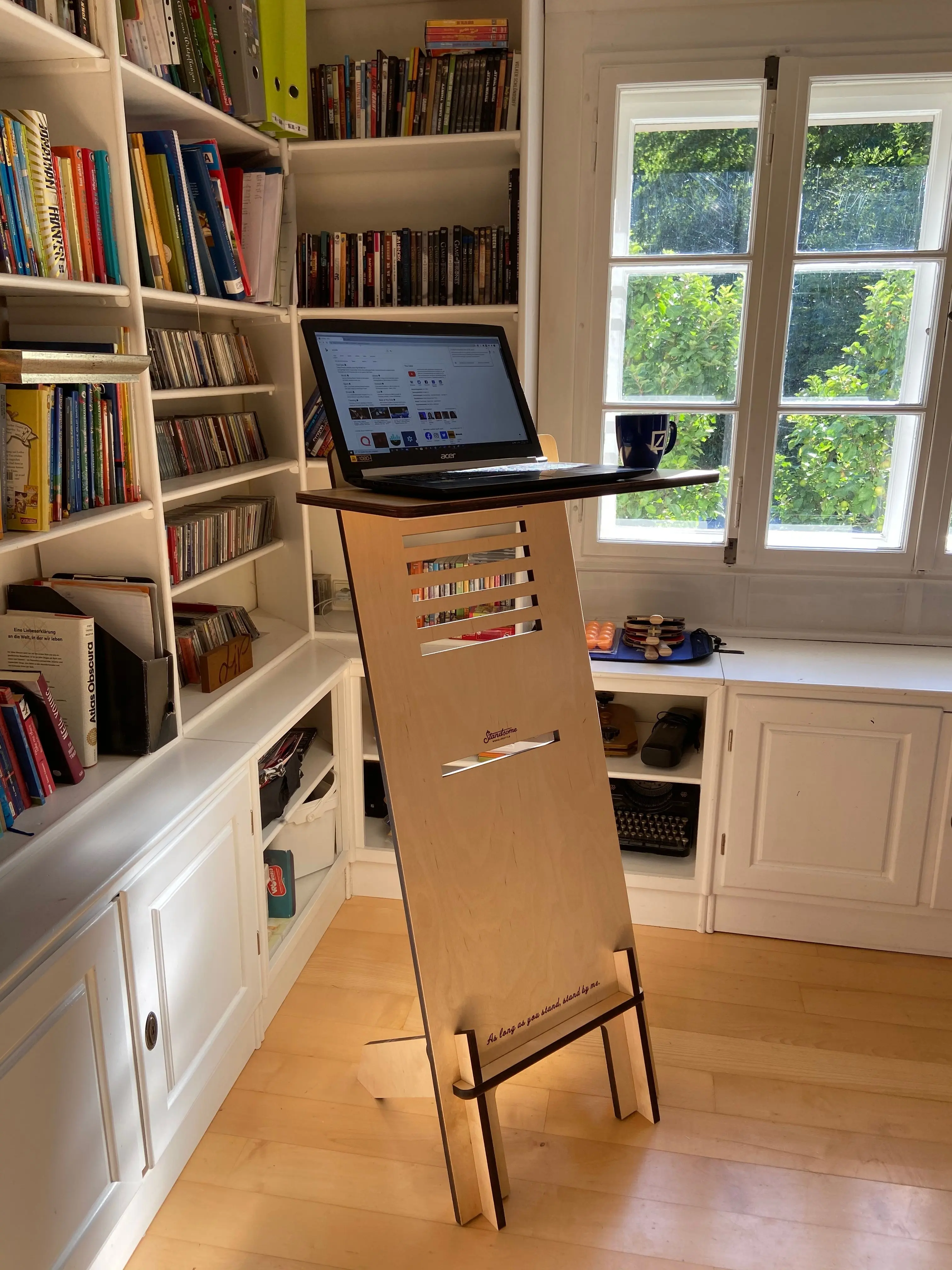
That doesn't make the standing desk useless — just misunderstood. It works not because standing is inherently beneficial, but because it makes it easier to alternate between sitting and moving. A randomised study involving 756 office workers found that a standing desk, combined with a simple accompanying programme, reduced daily sitting time by around one hour.
That was roughly three times as much as the same programme without the desk. People who find the motivation to stand up without any furniture achieve just as much. The tool doesn't replace the habit — it simply makes it easier to form one.
When it comes to longevity, the goal isn't just a longer life — it's more years spent healthy and mobile. Uninterrupted sitting quietly works against that goal, because a sluggish sugar and fat metabolism gradually ages your blood vessels over time. The good news is how simple the solution is.
You don't need a new training programme or an expensive device — just more interruptions to your sitting. What's been called the new smoking turns out to be a problem you can address several times a day in just two minutes. Those two minutes are more effective than any height-adjustable desk you stand at for hours on end.
Sitting is not the new smoking. But sitting for hours without a break is a real risk — and you don't beat it by standing still, but by moving.
All columns by Nils Behrens on premiummedicalcircle.com can be found here!

Will artificial intelligence replace doctors? Digital health expert Prof. Dominik Pförringer explains which tasks AI will take on in the future, where its limits lie, and why the personal doctor-patient conversation remains irreplaceable.
Christine Bürg & Marianne Waldenfels

An interview with
Univ.-Prof. Dr. med. Dominik Pförringer

The first GLP-1 weight-loss pill has been approved in the EU. Can it compete with Ozempic, Wegovy & Co.? Cardiologist Prof. Uwe Nixdorff explains the tablet's advantages and limitations compared with injections.
Christine Bürg & Marianne Waldenfels

With
Prof. Dr. Uwe Nixdorff