© © Janine Sametzky
January 21, 2026
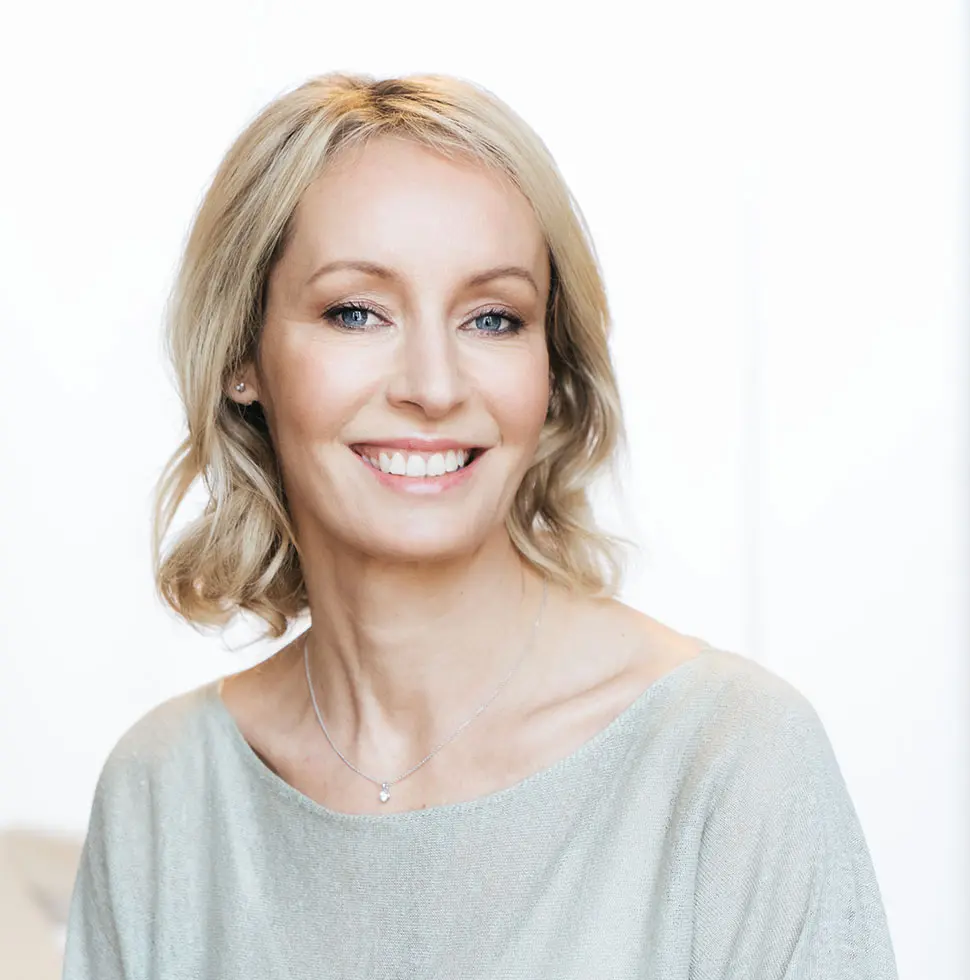
Dominik Pförringer
Curse or blessing? Digitalization in medicine is sparking intense discussions. Doctor and digital pioneer Dominik Pförringer advocates for the best of both worlds: artificial intelligence + empathetic humanity.

By
Univ.-Prof. Dr. med. Dominik Pförringer
Digitalization is ubiquitous and indispensable in our daily lives. Homo sapiens has become Homo semi-digitalis. Whether and to what extent this represents an upward or downward development is in the eye of the beholder. Primarily, an ever-growing amount of data is available anytime and anywhere. Any child can accurately say who landed on the moon or how many inhabitants Castrop-Rauxel has at practically any location. But is that per se intelligence, is that helpful, does it solve a problem? Those are facts, figures, pure data.
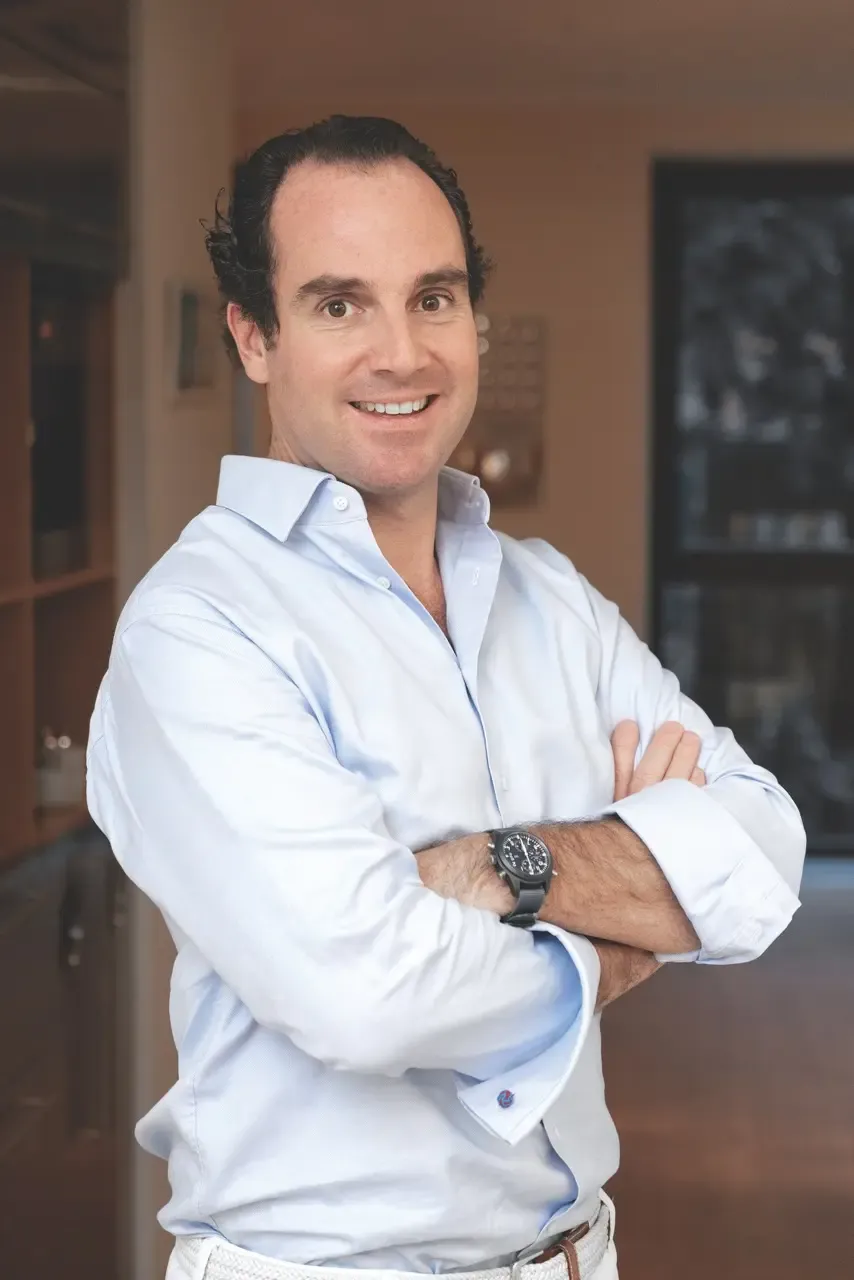
Prof. Dr. Dominik Pförringer is a specialist in orthopedics and trauma surgery in Munich and founder of the Digital Health Summit, which takes place annually in November. He is also the academic director of the TUM Venture Lab Healthcare. For years, he has been advocating for innovation through digitalization in healthcare.
Data is often mistakenly referred to as the oil of the 21st century – in fact, they represent crude oil. Specifically: the material from which humans can refine something with brain and creativity, i.e., further develop it. It's similar with health data, for example with laboratory values or image data. Only the overall context, the background, and especially the experience make it possible to derive something meaningful. In many situations, the dynamics are decisive, not the individual point value. Only the view of the experienced doctor, the assessment of the skilled clinician, allows the measured data to be interpreted and a focused therapy to be initiated based on an intelligent analysis.
It is in human nature to tackle, embrace, and shape new things with fascination. This often happens at such a speed that meaning and logic can be left behind. Things are calculated, numbers are aggregated that may not actually fit together. In doing so, causality and correlation are often confused. Let's think of the phrase: "With increasing ice cream consumption, the risk of forest fires increases" – not wrong in itself, just not causally dependent, but correlating.

Technology allows something, so humans do it. The sense is often questioned only later. In the most sacred of all fields, the art of healing, new developments often trigger unexpected fears and resentments. People feel threatened, left alone, and fears arise about the wave of innovation. But similar to technological development, these fears are often based on a lack of background knowledge. In the field of digital innovation in medicine, the majority lack a thorough understanding. Bad news travels fast – horror reports and grim messages spread quickly. Positive things are reported too seldom.
We rarely read: 'Patient treated more efficiently due to algorithm.' Or: 'Dataset saves patient.' Yet this is often true, and it's increasing. Anyone who deals with a topic like 'Next Generation sequencing' of a tumor knows how crucial data is for recovery and is glad and grateful that we use this technology.
Modern medicine shows daily how digital technologies provide concrete help:
This brings us to the Holy Grail and unfortunately one of the favorite topics of the Germans: data protection. In many places, doctors are already formulating it drastically and clearly: "Data protection is deadly." Because every day, doctors lack information for the adequate therapy of patients. These data exist, but they are not available. Either because they are protected, or because they are not transported. Intelligent minds are calling for a data traffic law to formulate the concept more openly a priori and thus enable a more proactive approach.
Associations like “Data Saves Lives” point out the positive potential of data from the patient’s perspective. Every pet in Europe is chipped, receives a data storage under the skin to obtain the European Pet Passport. Far too few people carry a comparable chip that can save lives by transporting vital information for emergencies, thereby accelerating and securing diagnostics and therapy. Just the proposal alone often causes outrage.
From my point of view, it is very similar to organ donation: As soon as enough people voluntarily participate, it creates enormous added value. But that is exactly where the crux lies: in voluntariness. As long as we have no standard, as long as it remains an express opt-in and does not become an opt-out, we have too few people on board. A pleasant look at Austria: There, an opt-out regulation – so everyone is a donor unless they explicitly object in writing – ensures that a sufficient supply of donor organs is available.
But in all the pondering about data and its benefits, the question of the deeper meaning must not be lost. For whom are we doing all this? From my point of view, for the main characters: the patients. Modern physicians see digitization as their intelligent co-pilot, not a threat. In the future, the question will no longer be whether someone wants to enable digitization, it will be much more precise: Who will still visit a doctor who operates purely analog?
Comparable to a commercial aircraft without autopilot assistance, hardly any patient will trust the doctor alone but will always want to know which technology supports the doctor. We already experience this today with the DaVinci robot in specific surgical procedures.
We are close to the goal of digitalization, in that digital helpers allow the doctor to have more time for their patients. No doctor should waste time on a keyboard but should use every second to focus entirely on the patient.
Digitalization will not replace the doctor, but the digitally working doctor will surpass the purely analog one.
Despite all the affinity for technology, it is important to focus on humanity. The exchange, the conversation, the encouraging words, the empathetic accompaniment, the alleviation of fears, and the radiance of confidence – all of these can and should never be taken over by artificial intelligence. This is the irreplaceable task of humans, of doctors. And that also explains why those who always spread fears, whether in relation to pandemics or climate scenarios, are isolated and ignored.
In this sense, it is important to overcome fears and focus on positive examples. Every person who can be helped by technology will be grateful for this opportunity and will be happy to share their experiences and digitally supported salutogenesis. Technology prevails when it removes obstacles and simplifies processes instead of increasing complexity.
Successful healing art is based on the intact relationship between doctor and patient. To quote cardiologist Bernard Lown: "Healing works best when art and science are united, when body and mind are explored together."
The greatest chance of success is therefore for those technologies that focus solely on the well-being of the patient and support the doctor in their healing art, without coming to the fore or even between doctor and patient. Let's remain optimistic in our expectations and exercise sensible judgment when it comes to the future of medicine. The technology that helps the patient and the doctor will prevail, and all the horrible things we are preached about will disappear. Because people want people, and the machine is used as an aid, not as a replacement for personal conversation.
As Abraham Lincoln already knew: "The best way to predict the future is to create it yourself" – in this sense, I advise all doctors and patients who have an idea to improve healthcare to try to implement it and thus become the creators of the future from the therapists of the present.