© Antoni Shkraba
September 27, 2026
Marianne Waldenfels
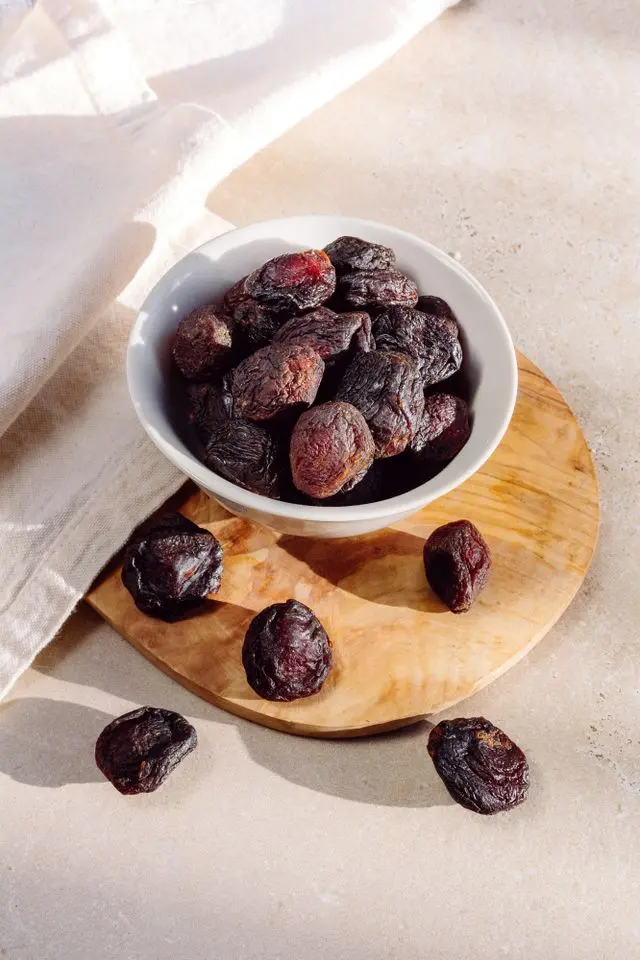
Prunes are best known for their effect on digestion. But research points to a completely different and surprising benefit: eating just four to six a day may help postmenopausal women preserve their bone density.
Prunes are not exactly the first food that comes to mind when you think of superfoods — they are mostly known for their fiber content and their ability to get digestion moving. Yet these unassuming fruits have been attracting the attention of bone researchers for several years now. Studies suggest that prunes may have an entirely different effect: slowing the age-related loss of bone mass.
What makes this particularly interesting is the amount involved. In a large long-term study of postmenopausal women, just 50 grams of prunes per day — roughly four to six pieces — was enough to produce a measurable difference in the preservation of bone density.
A new meta-analysis published in 2026 has now evaluated the existing randomized studies together for the first time. It too provides evidence that regular consumption could support bone health. So what can four to six dried plums a day actually do for our bones?
Our bones are anything but static: old bone tissue is broken down and new bone is built up throughout life. As long as these two processes stay in balance, bone remains stable. After menopause, however, that balance is disrupted: declining estrogen levels accelerate bone loss, bone density decreases, and the risk of osteoporosis and fractures rises. At the same time, low-grade, silent inflammatory processes in the body increase, which can further drive bone breakdown.
The idea that diet can play a positive role here is nothing new. Most people think of calcium, vitamin D, and protein. Prunes don't immediately seem to belong in that category.
Yet they contain a remarkable mix: vitamin K, potassium, copper, fiber, and above all a wide range of polyphenols. These plant compounds have antioxidant and anti-inflammatory properties, which makes them the most likely explanation for the effect on bones.
Researchers did in fact find changes in certain inflammatory markers and immune cells in women who ate dried plums for one year. Something else also stood out: not all women benefited equally. Those who responded well appeared to have a somewhat different composition of gut bacteria — which makes sense, since many polyphenols are first processed by gut microbes before the body can use them.
Which specific compound is ultimately responsible remains unknown. As is so often the case with food, it is probably less about any single substance and more about the interplay of many.
The most compelling evidence so far comes from a twelve-month randomized study involving 235 postmenopausal women. They were divided into three groups: one ate no prunes, one ate 50 grams per day, and one ate 100 grams per day.
After one year, a notable difference emerged, particularly at the hip. In the control group, bone density had decreased by an average of 1.1 percent. Among women who had eaten 50 grams of prunes daily, the loss was only 0.3 percent.
Prunes did not make bones denser. What matters is that less bone mass was lost. After menopause, this is an important effect, as bone loss can accelerate considerably during this phase of life.
It is also worth noting that more did not automatically mean better. The 100-gram portion showed no clear additional benefit for bone density and was harder for participants to stick to. This makes the smaller 50-gram portion particularly practical for everyday life.
50 grams corresponds to approximately four to six prunes, depending on size — a surprisingly manageable amount.
Several clinical studies on prunes and bone health have now been published. A systematic review with meta-analysis published in 2026 evaluated eleven studies involving a total of 747 participants.
In postmenopausal women, a slight benefit was found particularly at the lumbar spine. No clear differences were found at other measurement sites, including the hip. The results of the individual studies also varied considerably. The researchers therefore describe the findings as initial indications of a moderate benefit and emphasize that larger studies are needed.
In other words: the direction looks promising, but the proof is not yet there. No study has been able to show that prunes actually prevent bone fractures.
Men also lose bone mass with age, just more slowly. Whether prunes can help them too was investigated by a team at Florida State University. The one-year study published in 2026 examined 59 men between the ages of 55 and 80 who ate either 50 grams, 100 grams, or no prunes per day.
The results are sobering: when it came to bone density, it made no difference whether the men ate prunes or not. Only for certain blood markers reflecting bone turnover did the prunes groups fare slightly better. It is possible that an already adequate intake of calcium and vitamin D simply masked any additional effect. For men, the question remains open for now.
Prunes are easy to work in: eaten plain as a snack, chopped into muesli, or paired with plain yogurt and a few walnuts.
Like all dried fruits, they contain sugar and calories in concentrated form. 50 grams amounts to around 120 kilocalories. It therefore makes sense to enjoy them in place of other sweets rather than simply adding them on top of everything else.
Anyone who rarely eats prunes s is better off starting with two or three pieces. The fiber and the sugar alcohol sorbitol draw water into the intestine, which can cause bloating or diarrhea in sensitive individuals.
As interesting as the studies are, prunes are just one piece of a bone-healthy lifestyle.
An adequate intake of protein and calcium, good vitamin D status, and regular physical activity all play an important role as well. Strength training in particular provides the stimuli that help maintain both bone and muscle. In the case of existing osteoporosis, dried plums are no substitute for medically recommended treatment.
Especially for women after menopause, there is now serious evidence that these fruits can slow bone loss — and it doesn't take large amounts to achieve this: four to six pieces a day was sufficient in the most important study.
Whether prunes can truly protect against osteoporosis or bone fractures in the long term remains to be shown by further research. They are no substitute for strength training, calcium, and vitamin D. But as a small, practical addition to support bone health, they are well worth trying.

Hearing loss is linked to a higher risk of dementia – yet declining hearing often goes untreated for far too long. ENT specialist Prof. Dr. Christopher Bohr explains how hearing affects the brain and why it can be important to act early.
Christine Bürg & Marianne Waldenfels

An interview with
Prof. Dr. Christopher Bohr