© Magnific
November 9, 2026
Marianne Waldenfels
Eggs are packed with high-quality protein, vitamins, and essential minerals. But boiling, scrambling, or frying them can make a surprising difference to their nutritional value. Studies show that some cooking methods preserve nutrients better than others – and one popular preparation can lead to substantial vitamin D losses.
A soft-boiled breakfast egg, creamy scrambled eggs, or a crispy fried egg: eggs are among the most versatile foods around. They supply nearly all essential amino acids, as well as vitamin B12, vitamin A, selenium, and choline. The yolk also contains the carotenoids lutein and zeaxanthin, which are important for the retina, among other things.
But not all eggs are created equal — at least when it comes to preparation. Whether boiled, fried, or baked, the cooking method plays a significant role in how many nutrients are retained and how well the body can absorb them.
Cooking causes the proteins in an egg to unfold, making it easier for digestive enzymes to break them down. As a result, the body can utilize the protein in cooked eggs far more effectively than in raw ones.
Sensitive vitamins and carotenoids, however, can be lost in the process. How significant these losses are depends on the temperature, cooking time, and the specific nutrient involved.
When boiling, the temperature is naturally capped by the water. Unlike in a hot pan, the egg is never directly exposed to temperatures well above 100 degrees Celsius.
This benefits not only the proteins but also the many vitamins found in the yolk. A study on the nutrient composition of boiled egg yolk found that the total measured vitamin content did not decrease significantly through boiling. Vitamin A and various B vitamins were also largely preserved.
The picture is different for the carotenoids lutein and zeaxanthin. A study in the Journal of Agricultural and Food Chemistry compared boiled, fried, and microwaved eggs. Depending on the preparation method, approximately six to eighteen percent of the carotenoids studied were lost.
For protein digestibility and food safety, thorough heating is beneficial. Pregnant women, young children, older adults, and people with weakened immune systems should be especially careful to ensure their eggs are fully cooked through.
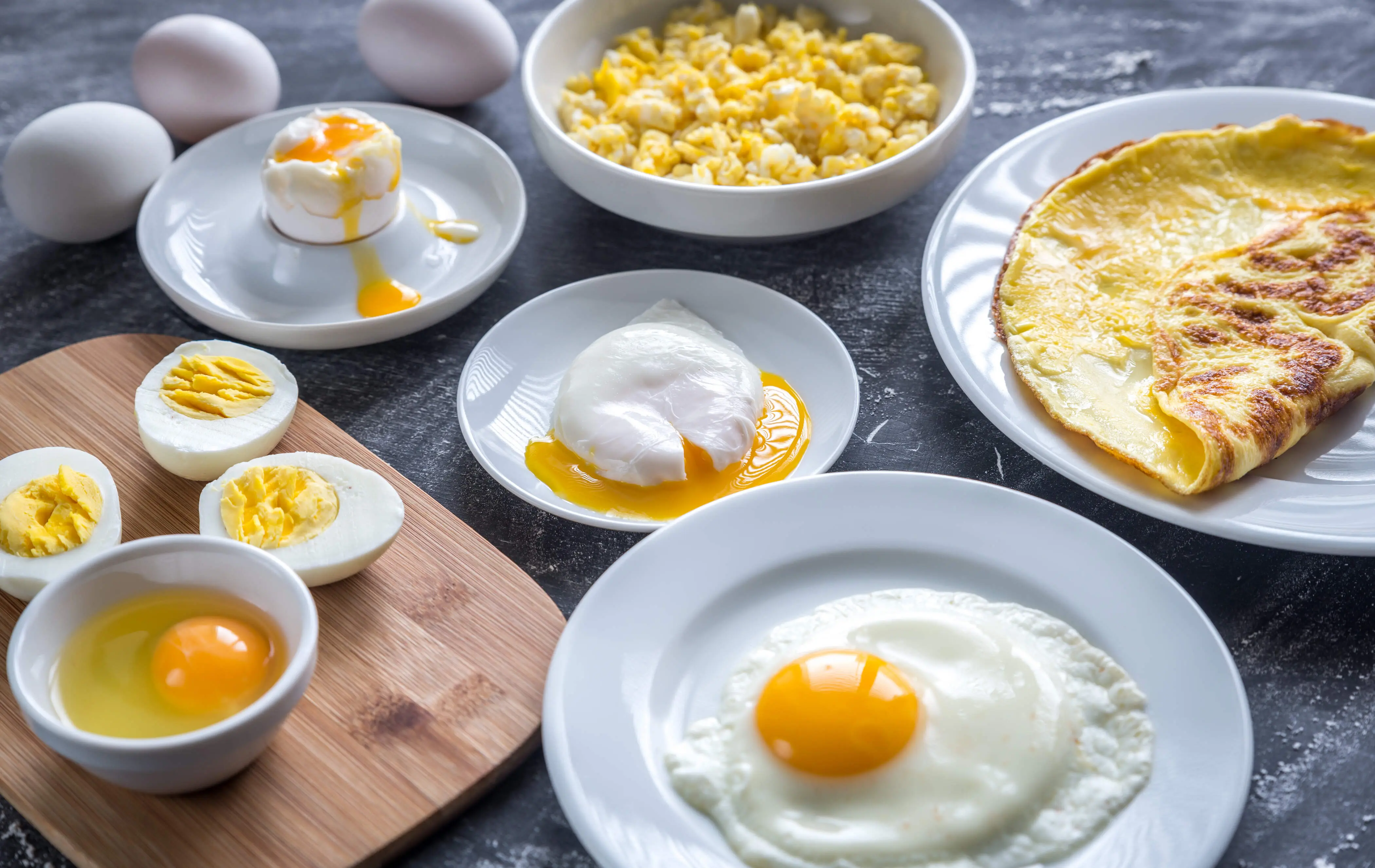
When frying, temperature is the primary factor determining how much stress is placed on sensitive compounds. The fats in the yolk in particular can undergo changes at high heat.
A study from the University of Alberta found that in eggs enriched with omega-3 fatty acids, more of these fatty acids were lost during frying and more oxidation products formed compared to boiling.
But the amount of nutrients retained is only part of the story — bioavailability matters just as much. A laboratory study from the University of Alberta showed through simulated digestion that lutein and zeaxanthin from scrambled eggs were less bioavailable than from boiled eggs.
In practice, this means: let scrambled eggs set slowly over medium heat, and avoid cooking fried eggs at high temperatures. This way the eggs are cooked through without being subjected to unnecessarily intense heat.
Poaching means cooking the egg without its shell in hot water. Unlike frying, no additional fat is needed, and the egg is not exposed to the high temperatures of a pan. The heat makes the egg white easier to digest. Whether poaching preserves more vitamins than boiling in the shell, however, has not yet been sufficiently studied.
Frittata, quiche, egg muffins — eggs can be prepared in the oven without any added cooking fat. However, one important nutrient in particular can be significantly lost this way: vitamin D. In a Danish study, after 40 minutes in the oven only 39 to 45 percent of the vitamin remained, compared to 82 to 84 percent when fried in a pan.
The fact that preparation method makes a significant difference for vitamin D retention is confirmed by a 2023 study from Newcastle University. In the vitamin D-enriched eggs studied, the highest levels of vitamin D were retained in scrambled eggs and in eggs prepared in the microwave. Hard-boiled eggs fared worse.
What matters, then, is not temperature alone but also cooking time. Anyone looking to preserve as much vitamin D as possible should opt for scrambled eggs over moderate heat rather than baking eggs in the oven for an extended period.
Ever since Sylvester Stallone drank five raw eggs from a glass as Rocky Balboa, raw eggs have held on in some fitness circles as a power food. Science tells a different story. Belgian researchers led by Pieter Evenepoel of the University of Leuven established as far back as 1998, using labeled protein, how much is actually absorbed in the small intestine: nearly 91 percent for cooked eggs, but only just over 51 percent for raw eggs.
A larger study from Maastricht University puts this into perspective somewhat. The team led by sports scientist Luc van Loon gave 45 trained young men five raw or five cooked eggs after strength training. The cooked eggs produced a greater rise in blood amino acid levels, but no measurable difference in muscle building was observed in the hours that followed.
There are two additional reasons to avoid raw eggs. Raw egg white contains avidin, a protein that binds the vitamin biotin. Only prolonged heating inactivates it completely; in poached or briefly fried eggs, some avidin remains active. A deficiency, however, is only a real risk for those who consume large amounts of raw egg white over a long period of time.
The salmonella risk is a more serious concern. The German Federal Institute for Risk Assessment recommends heating eggs for at least two minutes to a core temperature of at least 70 degrees Celsius. For pregnant women, young children, older adults, and immunocompromised individuals, raw eggs are off-limits.
Researchers at the University of Naples Federico II were also intrigued by the fact that the optimal cooking temperature differs between egg yolk and egg white. In a study published in 2025 in the journal Communications Engineering, they developed a new cooking technique designed to treat both components as gently as possible.
The challenge: egg white requires a higher temperature to set than egg yolk. With conventional boiling, it is therefore difficult to achieve the ideal consistency in both at the same time.
The scientists developed a method they call "periodic cooking." An egg is alternately placed for two minutes in water at 100 degrees Celsius and then in water at 30 degrees Celsius. This cycle is repeated eight times, for a total preparation time of 32 minutes.
The result: the egg white sets firm while the yolk remains creamy. In terms of the nutrient parameters studied, this method also performed favorably. The researchers found notable differences in particular in the content of certain polyphenols in the yolk compared to conventional cooking methods.
The study illustrates just how strongly temperature and cooking time can influence the properties of an egg. Whether this elaborate method yields long-term health benefits, however, was not investigated.
Gently boiled eggs are, overall, the best choice when the goal is to preserve as many nutrients as possible. The protein is easy to digest, sensitive compounds are comparatively well protected, and no additional fat is required.
Scrambled eggs and fried eggs can also retain many nutrients — the key is to cook them over medium heat rather than at high temperatures. When it comes to vitamin D in particular, scrambled eggs are actually a better choice than egg dishes baked in the oven for a long time. The most important rule of thumb: don't heat eggs more intensely or for longer than necessary.

A cold that isn't given enough time to heal can have serious consequences – even for young, athletic people. Cardiologist Prof. Dr. Uwe Nixdorff explains the warning signs of myocarditis, why exercising during an infection can be dangerous, and when it's safe to return to sports.
Christine Bürg & Marianne Waldenfels

An interview with
Prof. Dr. Uwe Nixdorff

A Hamburg orthopedic surgeon harvests tiny cartilage samples from the ear and injects them into arthritic knees. In this interview, Dr. Hans Olaf Baack explains who may benefit, what early studies show and why he avoids making promises
Christine Bürg & Marianne Waldenfels
An interview with
Dr. med. Hans Olaf Baack