
© Offenblende/Markus
September 18, 2026
Moira Hammes
- Health
Big Bang AI Festival: Between Data Spaces, Prevention, and Human Responsibility
How AI can transform healthcare — and why it takes more than powerful algorithms
Share article:
© Offenblende/Markus
September 18, 2026
Moira Hammes
How AI can transform healthcare — and why it takes more than powerful algorithms

 Find a Doctor
Search the network for suitable specialists and contact them directly
"Technology must advance Freedom" was the message on one of the panels at this year's Big Bang AI Festival. The statement captures a central question: How can technology be used in a way that reduces rather than adds complexity — supporting people, expanding their freedom to act, and freeing up time for what truly matters?
For Premium Medical Circle, the festival visit focused in particular on the insights surrounding thedigital transformation of healthcare. Artificial intelligence was a presence in almost every conversation. The most compelling discussions, however, were not solely about what is already technically possible. Instead, they centered on how innovations can be responsibly integrated into care — in an evidence-based, safe manner, and with tangible benefits for patients and medical professionals alike.
The Big Bang AI Festival bills itself as Europe's leading AI event for decision-makers. Over two days, more than 350 speakers from business, technology, healthcare, and politics came together. Across six stages, the program featured keynotes, panels, and masterclasses, along with extensive opportunities for professional exchange and networking.
A recurring theme across the panels was the lack of connectivity between the various systems and applications used daily in healthcare. Health data is collected at a wide range of touchpoints — by health insurers, in medical practices, hospitals, pharmacies, and rehabilitation facilities, as well as privately throughwearables.
Access to this data is often difficult, however, because it is scattered across numerous separate applications. For care delivery, this means that important information exists but is not always available where it is needed — for diagnostics, treatment, and continuous patient support.
Interoperability is the decisive factor here: it determines whether findings, medication data, and other relevant information can be consolidated across systems and made usable for care delivery, research, and the meaningful application of AI.
A similar perspective shaped the discussion around the electronic patient record. The ePA is increasingly evolving from a simple digital storage location into a central health data space that can, over the long term, connect care delivery, research, and AI. Medication data, e-prescriptions, vaccination and preventive care information, and medical documents all have the potential to deliver concrete added value.
"We now need to turn this usage into real utility. We need to define better care, and we also need to empower people [...] to engage willingly with their health data." That was Brenya Adjei, CEO of Gematik, on the next critical step.
It became clear that technical availability alone is not enough. In a general practice setting, the benefit only materializes when relevant findings are complete, standardized, and clearly presented in one place. For patients, the ePA must be understandable, accessible, and relevant in everyday life — so that they, too, are empowered to become active users.
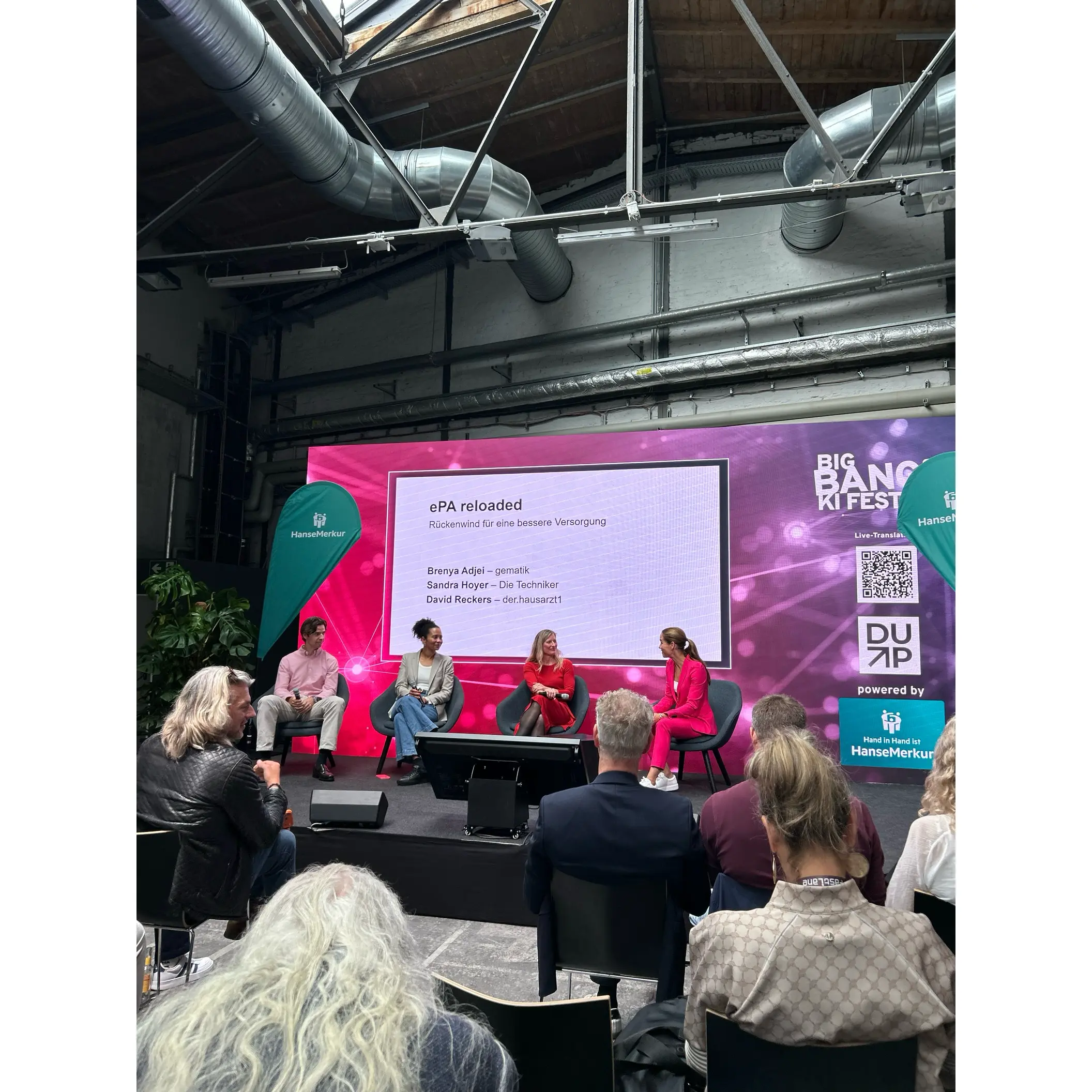
© Moira Hammes
Engaging discussion on the electronic patient record
The potential benefit ofartificial intelligence is most tangible where it supports specific workflows — for example, in documentation, structuring information, highlighting relevant findings, or preparing medical decisions. In hospitals, reduced bureaucracy could — as many physicians hope — free up time for direct patient care.
Dr. Gerald Gaß put the potential in stark terms: "If we could save just one hour of bureaucracy, that would be 20,000 full-time positions in medical services and 50,000 full-time positions in nursing services [that] we would have available for patient care."
At the same time, there was broad and repeated agreement in discussions that AI cannot replace professionals. Rather, AI should make suggestions, recognize patterns, and make information more quickly accessible. Professional judgment and final decisions must remain with physicians and nursing staff.
It is therefore especially important to involve those who work with these systems from the very beginning. Nursing and medical staff must not be confronted with ready-made solutions only after development is complete — they need to be part of the creation process.
The term shadow AI also came up in this context. Employees are already independently turning to freely available tools when official applications are too slow, too complicated, or simply unavailable. This shows that the practical need is real, but it also raises serious questions about data protection, liability, and patient safety. What is needed are secure, data-compliant, and practical solutions that give employees a reliable framework for using AI and genuinely address the needs of everyday practice.
The importance of representative data was illustrated by the look at women's health presented by Judith Gerlach, State Minister for Health, Care and Prevention. Women have long been inadequately represented in research, data collection, and care. Symptoms are still recognized later or not taken seriously, and conditions specific to women — such as endometriosis — often go undetected for a long time.
At the conference, specific funded projects were presented that aim to use AI for earlier detection ofbreast cancer and cardiovascular diseases, improved diagnostics forendometriosis and more individualized treatment of ovarian cancer.
"When we talk about AI in healthcare, it is not primarily about algorithms or technology. It is about being able to treat people better," emphasized Judith Gerlach. This idea applies to the entire discussion: AI becomes truly relevant when it closes gaps in care and delivers concrete benefits to people.
As diverse as the panel topics were, the shared direction was clear: digitalization and AI should improve the healthcare system in the fullest sense. This requires interoperability, high-quality data, robust evidence, and regulation that balances protection with innovation.
Trust, a willingness to change, and human responsibility are equally decisive.AI should be understood less as a solution in itself and more as a tool — one that supports professionals and better engages patients. The real gain lies in fewer friction losses, less bureaucracy, and more time for good care.
Perhaps the most fitting vision to emerge from one of the panels was the wish for "screen liberation" — that is, less time in front of a screen and more time for the people who need medical help and attention.

"Feel Good, Live Better" – in this podcast episode, Dr. Gesche Brannolte-Raab shares what each of us can do to reduce our risk of developing cancer.
Christine Bürg

An interview with
Dr. med. Gesche Brannolte-Raab

Deadline pressure, constant availability, little time to recover: stress is often unavoidable in everyday life. But when does it actually become a risk to the heart? Cardiologist Prof. Dr. Uwe Nixdorff explains why recovery is crucial — and how chronic stress can even be measured.
Christine Bürg & Marianne Waldenfels

An interview with
Prof. Dr. Uwe Nixdorff