© Freepik
March 6, 2026
Marianne Waldenfels
Is skyr good for your gut health? Here’s what microbiome research says about the Icelandic yogurt – and what to look for when buying it
It can be found in almost every German refrigerator, is considered a healthy snack, and is praised by fitness influencers as much as by nutritionists: Skyr. But while most articles celebrate Skyr for its protein content, one of the most exciting questions often remains unanswered – what actually happens in your gut when you eat Skyr regularly?
Recent microbiome research is increasingly providing concrete answers to this. And they show: Skyr is more than a protein-rich filler. Under the right conditions, it can be an effective tool to actively shape the gut microbiome. What science says about it – and what you should pay attention to when buying – you'll find out here.
Skyr originates from Iceland, where it has been made for over a thousand years. Originally, it was considered a staple food of the Icelandic population – durable, nutrient-dense, and filling. In Germany, Skyr is legally classified as low-fat fresh cheese, although its texture and taste more closely resemble a particularly firm yogurt.
The crucial difference from conventional yogurt lies in the production process: Skyr is made from fully skimmed milk, fermented with special Skyr cultures, and then filtered – the whey is separated. This filtration explains the high protein content: Skyr provides about 10 to 11 grams of protein per 100 grams, while plain yogurt contains only about 3 to 5 grams.
For gut health, however, it is not the protein content that is decisive, but the bacterial cultures used in fermentation – and whether they are still alive in the product after processing.
Here it is worth taking a closer look. Fermented does not automatically mean probiotic – and this is particularly relevant for Skyr.
According to scientific definition, a food is considered probiotic if it contains living microorganisms in sufficient quantity that demonstrably provide a health benefit to the host. Both conditions must be met: viability of the cultures and proven benefit.
Skyr is typically fermented with the following bacterial strains:
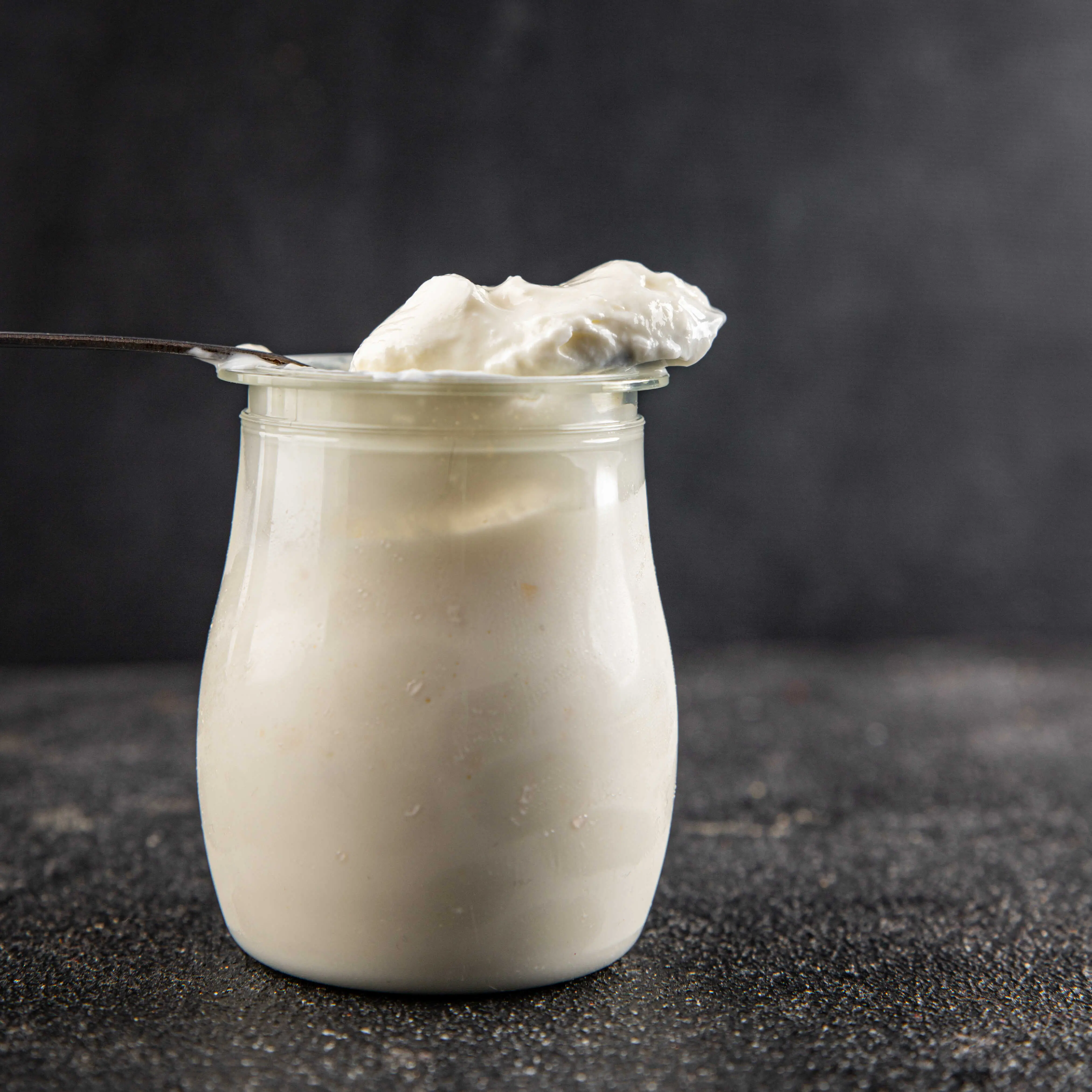
• Streptococcus thermophilus – a classic yogurt starter that breaks down lactose and influences the consistency
• Lactobacillus delbrueckii subsp. bulgaricus – works together with S. thermophilus and improves the aroma
• Bifidobacterium animalis subsp. lactis – a strain with well-documented effects on gut flora
The problem: Not all manufacturers transparently list the strains contained. And not all Skyr products in the supermarket still contain living cultures in relevant quantities – heat pasteurization after fermentation can kill the bacteria. Those who buy Skyr specifically for its probiotic effect should look for labels like "contains living cultures" or similar indications.
Scientific background: The WHO/FAO definition of probiotics (2001) explicitly requires proof of a health benefit in sufficient quantity. Fermentation alone is not enough. A Skyr whose cultures have been heat-treated after production does not provide a probiotic effect in the clinical sense – even if it is fermented.
The data on Skyr itself is still limited, but fermented dairy products have been in several human studies associated with a higher diversity of gut microbiota and an increase in classic probiotic strains like Lactobacillus and Bifidobacterium linked.
In an intervention with overweight women who consumed Skyr daily for four months, there was a significant increase in Streptococcus thermophilus and Lactobacillus delbrueckii subsp. bulgaricus in the stool – an indication that the fermentation cultures at least temporarily pass through the intestine and are detectable there.
In parallel, randomized studies with probiotic yogurt show that the daily consumption of common lactic acid bacteria strains can reduce inflammatory markers, improve the barrier function of the intestinal mucosa, and moderately reduce HbA1c in type 2 diabetes. These effects can be mechanistically plausibly transferred to Skyr due to the similar bacterial strains—provided the product demonstrably contains live cultures in sufficient quantities.
Not all fermented dairy products are the same for gut health. Here's a realistic comparison:
Kefir is the frontrunner from a microbiome perspective: It contains up to 30 different bacterial strains and yeasts, is very low in lactose due to the fermentation process, and has the strongest evidence for probiotic effects.
Natural yogurt also offers well-documented probiotic effects, but generally has less protein density than Skyr and, depending on the manufacturer, a less diverse bacterial composition.
Skyr is in the middle: higher protein content than yogurt, less bacterial diversity than kefir, but - in products with live cultures - comparable probiotic effects to good natural yogurt. It also has a low fat content and provides good satiety.
Quark usually no longer contains live cultures, as it is pasteurized after fermentation. While it provides a lot of protein and calcium, it has little probiotic value.
Conclusion of the comparison: If you want to specifically promote your microbiome, kefir is the best choice. If you want to combine protein and gut health, a high-quality skyr with live cultures is a good option.
Not every skyr in the supermarket is a microbiome friend. Many fruit and flavor variants contain sweeteners like sucralose or aspartame - and a critical look is worthwhile here.
According to EFSA, these substances are considered safe in usual consumption quantities, but are suspected in a growing number of laboratory studies to negatively affect the gut microbiome - specifically: to inhibit the growth of beneficial bacteria and burden the intestinal mucosa. The study situation in humans is not yet conclusive, but the signals are clear enough to be vigilant.
For maximum benefit, therefore, choose natural skyr without additives and refine it yourself with fresh berries, nuts, or a teaspoon of honey. This way you benefit from the probiotics - without potential downsides from artificial sweeteners.
Shopping tip: When buying, pay attention to the following points: "contains live cultures" on the packaging, the shortest possible ingredient list, no added sugar or sweetener in natural skyr, and organic quality where available - often fewer adjuvants are used here.
The effect of Skyr on the gut is not limited to the probiotic cultures. Two other ingredients deserve attention:
High-quality casein protein. The protein in Skyr is predominantly casein – a slowly digestible milk protein that is broken down gradually in the gut. Certain casein peptides have a prebiotic effect: they serve as a food source for beneficial gut bacteria and can thus indirectly strengthen the microbiome.
Calcium and intestinal mucosa. With around 150 mg of calcium per 100 grams, Skyr is one of the richest sources of calcium among dairy products. Calcium plays a role in the regulation of intestinal cells and the maintenance of mucosal integrity – an aspect increasingly studied in microbiome research.
Skyr is not equally relevant for everyone. From a medical standpoint, there are groups of people for whom the targeted consumption of Skyr can be particularly beneficial:
After taking antibiotics: Antibiotics hit the gut microbiome hard – they kill not only pathogens but also beneficial bacteria. Fermented products with live cultures can help regenerate the microbiome faster. Skyr is a practical and everyday addition here.
For irritable bowel syndrome: For people with irritable bowel, Skyr can be an alternative to full-fat yogurt – the very low fat content is often better tolerated by sensitive digestive systems. The reduced lactose content (due to fermentation and filtration, it is significantly lower than that of whole milk) also benefits many affected individuals.
During menopause: The high calcium and protein content makes Skyr interesting for women during and after menopause, when bone density and muscle mass are particularly worthy of protection. The probiotic effect can also contribute to overall immune competence.
With elevated blood sugar: The high protein content of Skyr slows gastric emptying and thus delays the rise in blood sugar after a meal. Studies on type 2 diabetics show that daily consumption of probiotic yogurt can significantly lower long-term blood sugar levels (HbA1c) – an effect that is also plausible for Skyr.
Skyr is no miracle cure – but when chosen correctly, it is a sensible part of a gut-healthy diet. The key points at a glance:
1. Skyr with live cultures can demonstrably positively influence the gut microbiome – the bacterial strains actually settle in the gut.
2. The probiotic effect is tied to the quality of the product – not every skyr on the market still contains live cultures.
3. Natural skyr without sweeteners is the clear choice – fruit skyr with sucralose or aspartame can neutralize or reverse the microbiome effect.
4. For maximum effect: Use skyr as part of an overall fiber-rich diet – probiotics need prebiotics as food.
5. Kefir remains the champion for microbiome diversity – but skyr offers the better combination of protein, probiotics, and everyday suitability.
Microbiome research is still in its infancy – but the available data paints a clear picture: Those who regularly consume high-quality skyr do something good for their gut. And those who do something good for their gut invest in far more than just digestion: in the immune system, mood, and long-term health.