© Sam Lion
June 5, 2024
Julia Werner
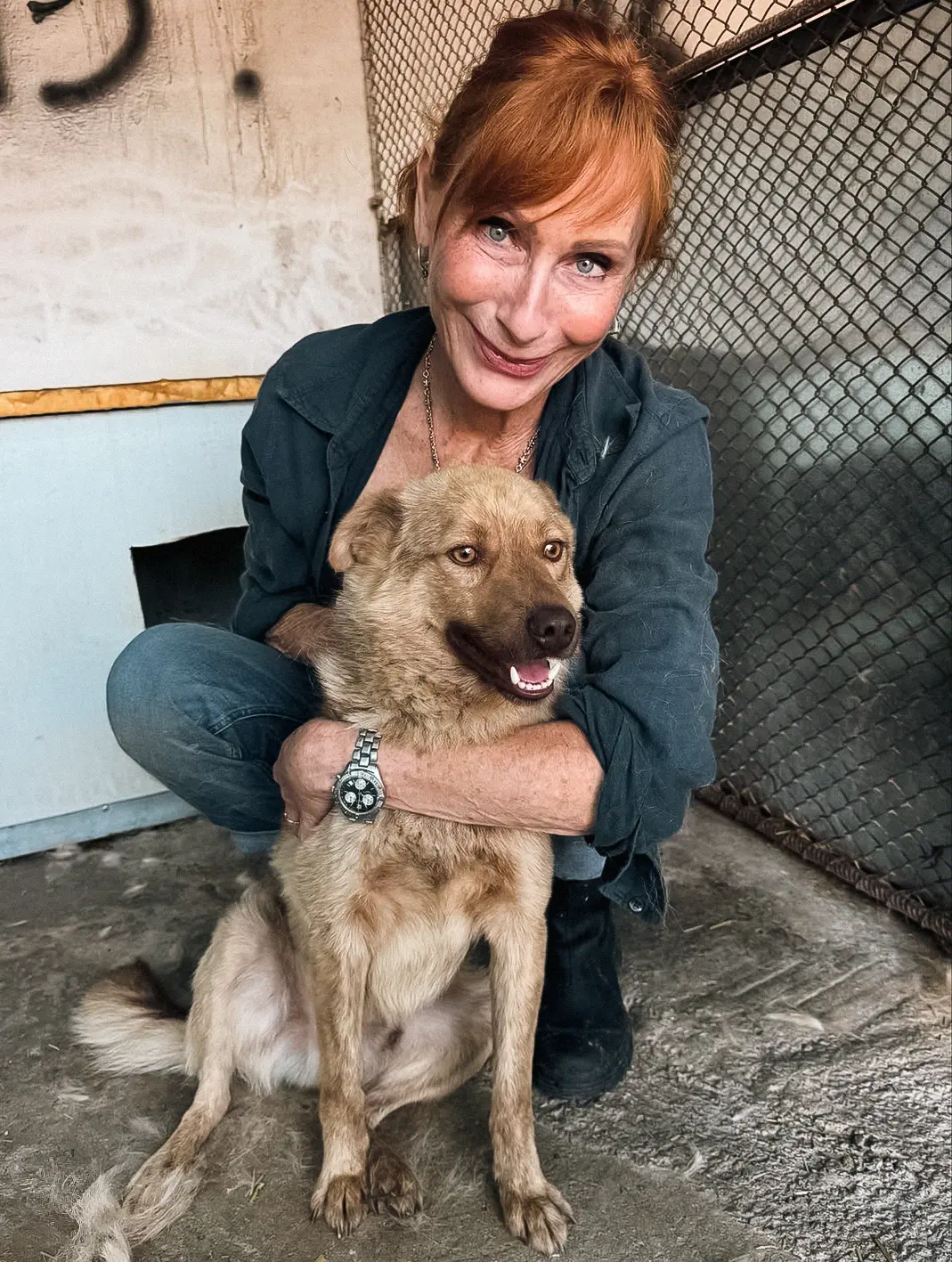
Animals—especially dogs—are particularly good caregivers and promote health. This is a conviction that our author does not stand alone in, as science increasingly supports her view.
Animals are healers and saviors in need, there is no doubt about it. The first four-legged caregivers can be found in antiquity: The god Asclepius, son of Apollo and father of medicine, was said to be always surrounded by snakes and dogs. After his death, the injured and sick dragged themselves to his shrine to spend the night and let the dogs living there lick their wounds, thus being healed by the god in dog form.
The Greek gods liked to transform themselves into animals anyway. Animism, the spiritual belief in certain abilities of animals, has shaped humanity for many centuries. It was characteristic of hunting societies. The Inuit still believe that hunted animals are capable of seeking revenge.
Therefore they are treated with the utmost respect, whether dead or alive. The Mayans believed in Chanul, their spirit animal – and that whatever happens to it also happens to oneself. In the culture of the Ojibwa, boys had to spend days in the wilderness until they were delirious, hoping to encounter their spirit animal there.
For the poor souls without an Animal Twin, there were shamans capable of communicating with animal protectors. Only much later, in the Middle Ages, were animals attributed with diabolical traits. By, surprise, the Catholic Church. Another good reason to burn women who didn’t fit into the patriarchal mold at the stake as witches.
The belief in the healing power of animals, however, was not easily eradicated. Even in Elizabethan England, doctors were convinced that a Cocker Spaniel positioned on a patient’s chest could absorb the suffering.
It was only with the Enlightenment that the great image polish came. City dwellers and nobles brought animals into the cities, and the recommendation of child psychologists for strengthening a sense of responsibility and empathy was pets.
The first professional animal healers were found by James Serpell (Handbook on Animal Assisted Therapy) in the 18th century in a mental asylum in York, England. There, rabbits, chickens, and cats lived in the garden, with which the mentally ill could talk. However, the absolute career low point for Doc Dog was the first half of the 20th century: The total reliance on modern medicine nullified the importance of animal soft skills. A mistake.
Because the state of scientific studies today is: Animals as caregivers are a good idea. When singles live with a dog, their risk of cardiovascular diseases decreases by a third, as the biggest risk factors are lack of exercise and social isolation. The mere presence of a relaxed animal lowers blood pressure and promotes the release of the feel-good hormone oxytocin.

It has pain-relieving, anxiety-reducing, calming effects. Dogs can also sniff out cancer and corona viruses (or rather: their metabolic products) and, as trained assistance dogs, warn diabetes patients of blood sugar emergencies. Researchers assume that they recognize the so-called isoprene in human breath, which doubles during a blood sugar drop.
Dogs help autistic children regulate their stress levels, guide the blind across the street, and prevent people with post-traumatic stress disorder from committing suicide (US President Joe Biden signed the PAWS for Veterans Therapy Act in 2021, giving war veterans with mental health issues access to service dogs).
So it should have long been beyond question that life without animals – following Loriot – is possible, but meaningless. The health insurance covers the cost of a guide dog. However, therapies such as riding therapy are still mainly funded through donations.
IAHAIO, the international umbrella organization for human-animal interaction organizations, distinguishes between two types of animal help: animal-assisted therapy and animal-assisted intervention. The former involves therapeutically guided activities, such as riding. The second type includes activities like visits from a human-animal team to hospitals, nursing homes, or other care facilities.
What happens is not statistically measurable, but it's increasingly visible on Instagram: when ponies in England visit bedridden elderly people, lay their soft noses on the bed, and an old man or woman suddenly laughs. Or when a US-American woman with her "Unstoppable Dogs" team – paralyzed or amputated dogs – visits children who have to get used to life with a prosthetic leg. The dogs, despite wheelchairs and prosthetics, dart around full of life. They are role models.
People who don't consider themselves animal people – who don't exclaim 'Big Streeetch!' when a dog stretches nearby or a cat lounges in the sun – won't be impressed by this. They will still not see the need for animals in their lives and will criticize others' love for animals as anthropomorphizing.
Meanwhile, anthropomorphizing, as it's called in technical jargon, is on the path to rehabilitation, thus quite legitimate, because it seems to be the only way for people to understand animals' needs, behaviors, and intentions.
My theory about people who don't care about animals: They're afraid. Because deep down, they sense that animals are mirrors, and when we connect with them, we see who we really are.
The assumption is not based on studies, but solely on my own experiences. The first important animal in my life was Minosch, the pony stallion, once rescued from slaughter, later a proud, casual horse. He accompanied me throughout my youth and saved me from loneliness because I was a socially isolated child due to migraines.
It taught me everything needed in life – empathy, patience, trust. And self-defense: it liked to snap the bras of unsympathetic rowdy riders in passing. The fact that I have still not fully internalized the most important lesson, setting aside the ego, in my later life can only be because he left the planet.
One cannot force a horse to perform a piaffe or to walk over a plastic sheet. A lesson that managers must learn in horse leadership seminars. Horses are the best human readers in the world. Our upright shoulders, our step forward must be genuinely intended.
They analyze our body language, and only when we have convinced them that we are kind, far-sighted, and above all unflappable partners will they do anything for us. In this sense, such management seminars can be described as healing therapy.
Because the horse forces the manager to confront themselves and not just memorize the right body language. The horse makes him ask himself who he wants to be.
My current “Emotional Support Animal” is Theo, a fox terrier. He not only saved me from absolute desperation during the first Corona lockdown, keyword daily structure. But also slept on my lap for three weeks. At that time, I had forgotten what physical contact felt like. He wanted contact, nothing else. Just like us humans, but we suppress that too often.
Theo is scared of many things, so I spend most of my time identifying and avoiding potential shock moments in advance. Not only does this make me a more empathetic person. I tend to have fits of rage. The dog starts trembling terribly, even though I haven’t yelled at him. So I’ve simply stopped the fits of rage, without a two-legged psychotherapist.
Perhaps animal skeptics should first try it with more distance. With birdwatching, for example. A study published in Scientific Reports in October 2022 states that just seeing or hearing birds can improve mental health for eight hours.
The study participants used an app to log their moods and note whether they could see or hear birds. People with and without depression felt significantly better when they encountered birds.
Another study found that bird diversity in urban neighborhoods was associated with a lower prevalence of depression, anxiety, and stress. Another example: A study for the journal Ecological Economics showed a connection between happiness and the number of bird species near homes and cities.
Happiness is typically defined here as human: the proximity of 14 additional bird species is as satisfying as $150 extra income every month, according to scientists. You could also say: Sit down and be grateful that this very bird chose your balcony at this very moment; this is the simplest form of healing mindfulness.
There are even people who rely on their pet's insight into human nature. There is no scientific evidence of a preference or aversion towards psychopaths. But one of the most important figures in the history of psychology believed in it: "If Jofie doesn't like someone, something is wrong with them." This sentence is from Sigmund Freud.
The father of psychoanalysis and animal hater came to have a dog late in life, at 72 years old. Chow bitch Jofie was present at every therapy session, and Freud supposedly observed her reactions to the patient. Additionally, she always ended the session by standing up exactly when the time was up.
In 1936, he wrote to Marie Bonaparte, also a Chow fan, that a dog brings its owner "affection without ambivalence," liberating life from the "difficult-to-bear conflict with culture," being the "beauty of a self-contained existence."
And despite all the foreignness of organic development, the feeling of an intimate kinship, an undisputed togetherness." Much more than his patients, his three Chows probably healed him.
By the way, my soul horse and I sometimes still gallop in my dreams, and I wake up very happy. The thing with soul animals is just true. Feel free to call me an animist.