- München und Umgebung
- Radiology and radiation therapy
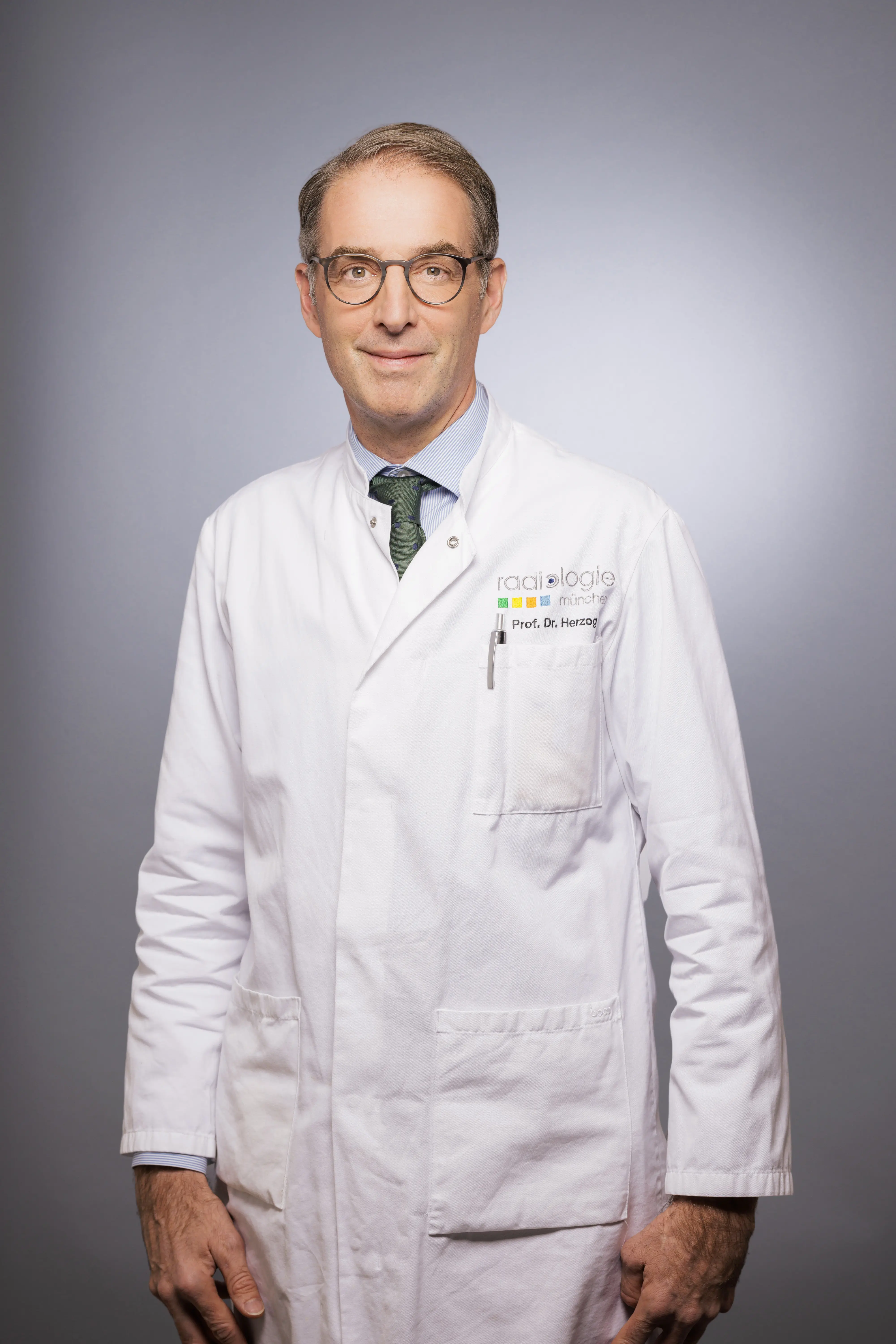
Prof. Dr. Christopher Herzog
Radiologie im Rotkreuzklinikum
Services
The Look Behind the Images
Prof. Dr. Christopher Herzog is one of the radiologists who was there from the very beginning when modern cardiac CT diagnostics were developed and introduced in Germany — and yet, for him, it is neither the machines nor the images that take center stage. It is the people who sit before him, carrying profound uncertainty.
That radiology would one day fascinate him so deeply was far from obvious at first. He had originally wanted to become a surgeon, just like his grandfather and uncle. In the middle of his studies, he became so captivated by neurosurgery that he seriously considered pursuing it. A stint in otolaryngology followed. He was always searching for his place. At one point, he even considered leaving medicine altogether. Interviews at McKinsey and Boston Consulting were already underway, and he had begun an MBA in parallel.
In the end, he made a conscious decision to return to medicine — and to a specialty that, for him, combines analytical thinking, technical expertise, and a holistic view of the patient. "The radiologists were the cool ones," he says today with a smile. "They always knew everything." At University Hospital Frankfurt, Prof. Dr. Vogl, one of the defining figures in radiology, became his next great mentor.
"Cardiac CT is actually the most rewarding imaging you can do."
Prof. Dr. Christopher Herzog
This decision came at a time when radiology was changing rapidly. In the early 2000s, it became increasingly clear that computed tomography had the potential to fundamentally transform cardiac diagnostics. Until then, coronary artery disease could mostly only be assessed indirectly, or confirmed with certainty through invasive cardiac catheterization. Modern CT systems promised a gentler alternative for the first time — but this technology still had to be developed and brought into everyday clinical practice.
Prof. Dr. Herzog was part of this development from the very beginning. As a medical consultant at Siemens Healthcare, he worked on the first generations of modern cardiac CT systems, helped develop examination protocols, and contributed to establishing standards that are taken for granted today. The questions were fundamental: How can a beating heart be imaged sharply at all? When should contrast agent be administered? What settings produce images that physicians can truly rely on?
"That was real groundwork," he recalls. Much of his knowledge had its roots in neurosurgery, which meant he was quickly regarded as a CT specialist even as a resident. Even when he occasionally lacked certain diagnostic fundamentals, no one could match his command of the technology. After passing his specialist board exam, his path took him via Siemens for two years to the Medical University of South Carolina (MUSC) in Charleston, at the time one of the leading centers for cardiac imaging. He then brought that experience back to University Hospital Frankfurt as a senior physician.
Eventually, the Munich-born physician answered a call to return to his hometown, to the Rotkreuzklinikum. Today he is a partner at the Gemeinschaftspraxis Radiologie München, based at the Rotkreuzklinikum, adding a "matter close to his heart" to the portfolio of 12 highly specialized locations. He has now performed well over 200,000 cardiac CTs.
"Whether AI makes the finding or I do doesn't really matter. Because my job begins after that."
Prof. Dr. Christopher Herzog
Cardiac CT continued to evolve. What is known as dual-source technology brought the next decisive step: equipped with two tubes and two detectors, it made it possible for the first time to capture sharp images of the beating heart — even at higher heart rates. Even the smallest coronary arteries can be visualized precisely and without distortion at high spatial resolution. This is possible because the acquisition time is shorter, which also means significantly lower radiation exposure. In imaging terms: "It's like turning on the shower and running through it quickly — you get less wet that way."
The latest dual-source CT marks the beginning of a new era in cardiac imaging. For Prof. Dr. Herzog, it is one of the most important tools for detecting coronary artery disease early or ruling it out with confidence — and it makes a decisive contribution to cardiology as a whole. For many patients, it means a brief, non-invasive examination in place of a diagnostic cardiac catheterization. Above all, it provides clarity — often long before symptoms appear. "Cardiac CT is actually the most rewarding imaging you can do." Why? Because it gives people certainty. Either coronary artery disease can be ruled out, or changes are detected early enough for timely treatment. "You either make patients happy because you can tell them: 'There's nothing there.' Or you find something early enough to change their lives."
For Prof. Dr. Herzog, the examination therefore does not end with the completed report. "My job actually begins after that." Images alone do not answer questions. For him, experience means above all knowing how to interpret results correctly. Not every calcification calls for a cardiac catheterization. Not every abnormal finding is immediately threatening. Conversely, there are patients in whom little appears to be wrong at first glance and who nevertheless carry a high risk. "The art lies in correctly identifying the right patient as sick and the right patient as healthy." That, in his view, is the true medical task.
This is also how he approaches his work in oncology and interventional radiology. Here, it is not only a matter of making tumors or metastases visible, but of initiating the next step: taking tissue samples, rapidly clarifying ambiguous findings, or working together with treating colleagues to determine the further course of therapy. Those confronted with a cancer diagnosis often lose their footing at first. Prof. Dr. Herzog tries to bring structure to a situation that, for many patients, initially consists of nothing but fear. "You become something more like an advocate for the patients." For him, radiology therefore means not only diagnostics, but accompaniment. "I have a plan" — four simple words that in that moment matter more to patients than almost anything else. They need to understand what a finding means — and above all, what happens next.
"For me, it has always simply been about helping people and making them well — in whatever way that may be." This includes early detection, for example through cardiac CT: a smart way to "look inside" without much effort.
"With cardiac CT and good patient management, we can massively reduce mortality from heart attacks."
Prof. Dr. Christopher Herzog
Additional Services
- Image-Guided Biopsies & Drainages
- Computed Tomography (CT)
- Diagnostic Neuroradiology
- Whole-Body MRI
- Cardiac CT
- Cardiac MRI
- Cardiovascular Radiology
- Pediatric Radiology
- Musculoskeletal Radiology
- X-Ray Diagnostics
- Sonography (Ultrasound)
- Thoracic Radiology
- Tumor Interventions