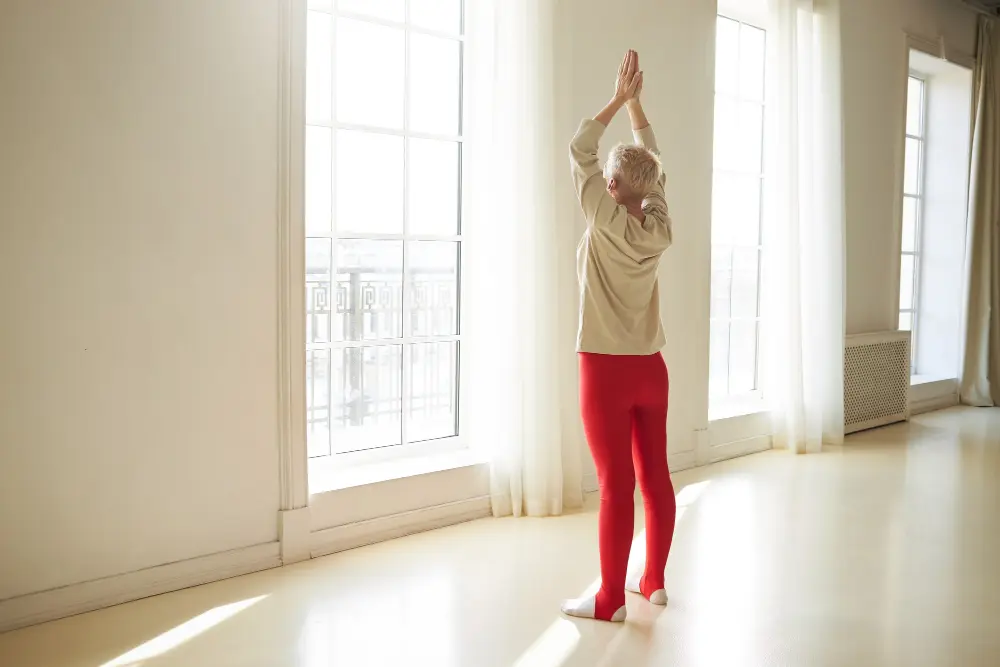
It takes just a few seconds and requires neither a wearable nor a gym: stand up straight, lower yourself to the floor, and then get back up — ideally without using your hands or knees for support.
What sounds like a simple mobility challenge is actually a scientifically studied fitness assessment. The Sitting-Rising Test, or SRT, measures several abilities at once: muscle strength, flexibility, balance, and coordination. A long-term study published in the European Journal of Preventive Cardiology in 2025 found that performance on this simple test is linked to long-term health.
How the Sitting-Rising Test Works
Each movement — sitting down and getting back up — is worth a maximum of five points, for a total of ten. Completing both movements without using the hands, knees, or any other support earns a full score. One point is deducted for each additional support used, and half a point for a noticeable loss of balance. Crossing the legs is permitted.
What makes the test interesting is that a single movement demands several physical abilities at once. The legs need strength, the hips and joints need flexibility, and balance and body control are essential too. The study's authors therefore regard the test as a straightforward marker of so-called non-aerobic fitness.
The Better the Score, the Lower the Mortality
The study included 4,282 men and women between the ages of 46 and 75, who were then followed for more than twelve years. During that time, 665 participants died of natural causes.
A clear pattern emerged: the lower the score, the higher the mortality. Of those who achieved the maximum ten points, 3.7 percent died during the observation period. At eight points, the figure rose to 11.1 percent, and among those with the lowest scores — between zero and four points — it reached 42.1 percent.
These figures reflect observed mortality rates over a median follow-up period of more than twelve years — not any individual's risk of dying as a direct result of a poor test score.
Part of this large difference can be explained by the fact that people with lower test scores may, for example, be older or carry a greater burden of illness. Even so, after the researchers statistically accounted for factors including age, sex, body mass index, and various medical conditions, the association held: those in the lowest-scoring group had approximately 3.8 times the risk of dying from a natural cause compared with participants who achieved a full score.
Why Can Such a Simple Movement Reveal So Much?
Unlike a conventional endurance test, the SRT simultaneously assesses multiple components of physical fitness, all of which have been linked to health and survival in older age. In this sense, the test distills them into a single everyday movement.
This also has a very practical dimension: anyone who falls needs to be able, ideally, to get back up from the floor on their own. The ability to do so is therefore also a measure of physical independence.
What a Poor Score Means — and What It Doesn't
Striking as these differences are, no personal life expectancy can be derived from a test result. The study demonstrates an association, but does not prove that difficulty getting up is itself responsible for higher mortality.
The study's participants were also not representative of the general population. They came from a private clinic in Rio de Janeiro, around two-thirds were men, and most belonged to higher education and income groups. People with musculoskeletal complaints or limitations that would have affected their performance were excluded. Age also plays a role: earlier data show that average scores tend to decline over the years.
Anyone with knee or hip problems, dizziness, balance disorders, or other physical limitations should not feel compelled to attempt the test.
A low score can nonetheless serve as a signal that physical abilities such as strength, flexibility, or balance have declined — and these can be improved even in older age. Whether doing so would enhance not only the test result but also life expectancy, however, cannot be concluded from this study.
Perhaps that is precisely where the test's strength lies: it requires no equipment and reveals within seconds how well our bodies can still perform one of the most fundamental movements of everyday life — getting back up off the floor on our own.