© Hans
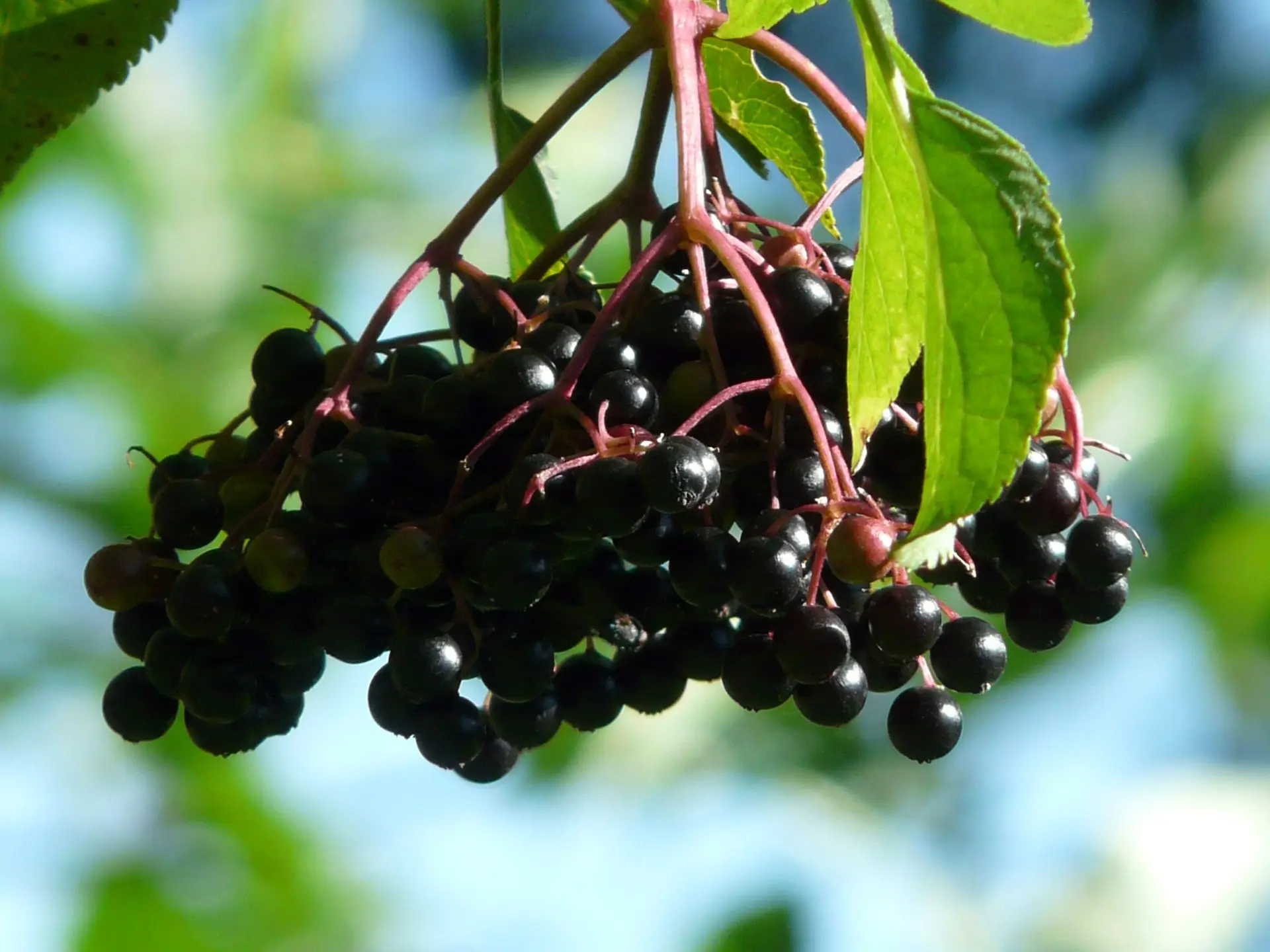
Elderberries contain anthocyanins, which give them their deep purple color and have powerful antioxidant properties.
November 25, 2026
Marianne Waldenfels
Elderberry has been used as a home remedy for colds for centuries. A new scientific review examines its potential to relieve symptoms and shorten illness. But not all elderberry products are equally well studied.
Hot elderberry juice is one of those home remedies our grandmothers swore by for colds. Today, the berries of the black elder (Sambucus nigra) are also available as capsules, syrups, and lozenges. Some people take these preparations throughout the entire winter, while others only reach for them when their throat starts to feel scratchy and their nose begins to run.
An international team of researchers examined, in a review published in October 2026, which herbal remedies help with respiratory infections. The scientists evaluated 18 analyses covering 16 different herbal remedies. Black elderberry is among the plants — alongside ginseng, ivy, echinacea, and eucalyptus — for which evidence of a therapeutic benefit was found.
One of the included meta-analyses with a total of 180 participants concluded that elderberry preparations can significantly relieve symptoms of colds and flu-like illnesses. The review therefore counts elderberry among the most promising herbal remedies for respiratory infections. However, larger clinical trials are still needed before a clear treatment recommendation can be made.
But can elderberry also shorten the duration of a cold?
In a study published in 2016, scientists from Australia's Griffith University studied 312 air travelers. Starting ten days before a long-haul flight, participants took either elderberry extract or a placebo.
A similar number of people in both groups caught a cold. However, those in the elderberry extract group who did fall ill experienced symptoms for an average of just under five days, compared with nearly seven days in the placebo group. Symptoms were also milder in the elderberry group.
Because only 29 of the 312 study participants caught a cold, the result does not yet constitute reliable proof of efficacy. Additionally, some studies on elderberry have been funded by manufacturers.
Anyone who has ever processed elderberries knows how stubbornly the dark juice clings to skin and clothing. The culprit is anthocyanins — the plant pigments with antioxidant properties that also give blackberries, blueberries, and blackcurrants their deep color.
Scientists at the University of Sydney discovered in a laboratory study published in 2019 that compounds in elderberry can make it harder for influenza viruses to enter cells and can inhibit their replication. Whether these effects translate to the human body has not yet been established.
For true influenza, elderberry initially appeared to be a promising remedy. In a study published in 2004 with 60 patients, symptoms improved on average four days earlier with elderberry syrup than with a placebo.
But when American scientists re-examined elderberry's effect years later, the earlier success was not replicated. In their study published in 2020 with 87 flu patients, neither the duration of illness nor the severity of symptoms was lower than in the placebo group. Patients had begun taking elderberry within 48 hours of their first symptoms appearing.
Elderberry as a remedy for influenza should therefore not be relied upon.
Based on the current state of research, those who take elderberry preparations throughout the entire winter to protect themselves from colds are unlikely to be getting much benefit for their money. Berry extracts are more worth trying once cold symptoms have already set in. That said, there is not yet a scientifically proven optimal time to start taking them.
To help shake a cold more quickly, reaching for a concentrated elderberry extract — in the form of capsules or syrup — is the better choice. Most clinical studies have been conducted using such preparations.
When buying elderberry syrup, however, it pays to read the ingredient list carefully: a fruit syrup made mainly of sugar and elderberry juice is not comparable to the concentrated extracts used in studies.
Ordinary elderberry juice also contains valuable anthocyanins, but their concentration depends heavily on the berry variety, how the juice is processed, and how it is stored. A shortening of cold duration has not yet been demonstrated for elderberry juice.
Elderflowers are traditionally used at the first cold symptoms. For a scratchy throat and irritated mucous membranes, a hot elderflower tea can be soothing. The European Medicines Agency (EMA) recognizes elderflowers as a traditional herbal medicine for relieving early cold symptoms. This classification is based on long-standing use rather than clinically established proof of efficacy.
Unlike blueberries or blackberries, elderberries are not suitable for eating straight off the bush. They contain, among other things, sambunigrin, a compound from which cyanide can be released in the body. This can cause nausea, vomiting, and diarrhea.
Anyone making elderberry juice at home should use only ripe fruit, carefully remove the berries from the stems, and heat them thoroughly. The toxic compounds are broken down during cooking.
According to the National Center for Complementary and Integrative Health, there is currently insufficient safety data on taking elderberry preparations during pregnancy and breastfeeding. People who take medications to suppress the immune system should also consult a doctor before taking elderberry. According to the U.S. National Institutes of Health, the compounds in elderberry could interfere with the effectiveness of these medications.

"Feel good, live better" – in this episode, Dr. Caroline Werkmeister talks about her favorite topic: feet. And what they reveal about your lifestyle.
Christine Bürg

An interview with
Dr. Caroline Werkmeister

Blood pressure, cholesterol, blood sugar – routine check-ups help assess many health risks. But what can our genes reveal about diseases that may not develop until years later? In her column, human geneticist Dr. Laura von der Heyden explains the potential and limitations of genetic testing in preventive medicine.
Dr. Laura von der Heyden

By
Dr. med. Laura von der Heyden

Losing your sense of smell can be dangerous: more than one in three people affected has failed to notice smoke or similar warning signs. ENT specialist Prof. Dr. Frank Haubner explains when to see a doctor, what causes distorted smells, and why recovery is possible even years later.
Christine Bürg & Marianne Waldenfels
An interview with
Prof. Dr. med. Frank Haubner