© Rikky Fernandes/Judy Casey
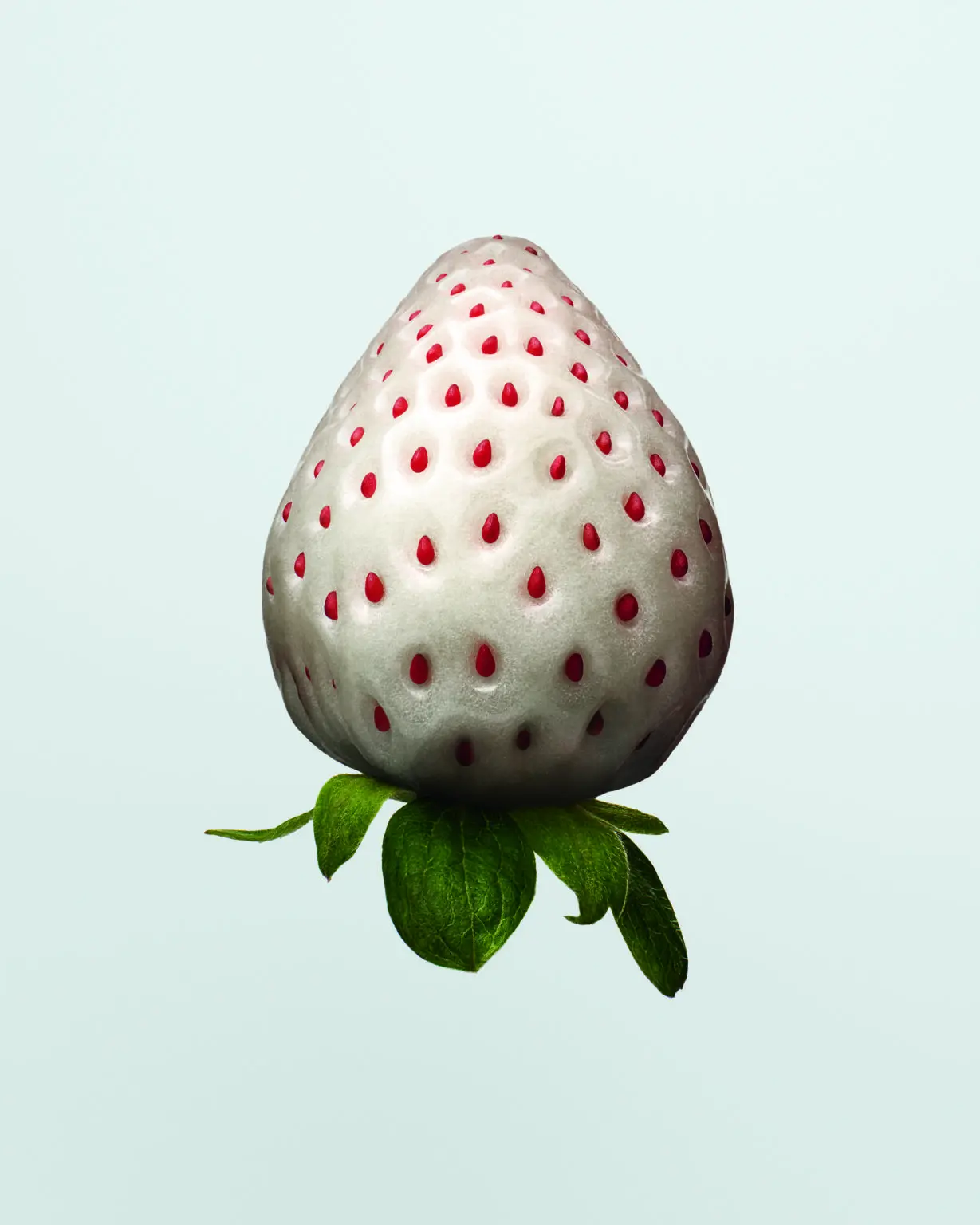
Not unripe, but a special variety: "Snow White" strawberry
November 2, 2023
Marianne v. Waldenfels
Why some melons cost over 20,000 euros: The passion for perfect fruits also leads to quirky cultivations. Especially in Japan.
Caviar, truffles, and company face new competition. The latest status symbols in foodie circles are: melons. The Japanese varieties "Yubari King" and "Densuke" are among the most expensive and rarest fruits in the world. They are auctioned off for hefty prices, especially the first specimens of the season are in high demand.
In 2019, two "Yubari King" specimens were auctioned for the equivalent of more than €20,000. The flesh of the round, visually unassuming "Yubari King" melons, with their finely netted rinds, is extraordinarily sweet and juicy, but this alone doesn't explain why such a high price per piece is demanded. This is primarily due to the way they are cultivated. They are grown on the Japanese island of Hokkaido in the north, in Yubari.
Once, the small town with its 7,000 inhabitants lived from coal mining. But then, in the 1980s, one mine after another had to close. The city was on the verge of bankruptcy – and reinvented itself. Today, about 100 farmers cultivate the prestigious luxury melons with great finesse and dedication.
They grow and thrive in underground, heated greenhouses. They are watered with warm water, and extra bees from the warm south of the country are delivered for pollination. Each fruit is, of course, harvested by hand.
In Hokkaido, another exquisite type of melon is cultivated in strictly limited quantities – the "Densuke" watermelon. There are only 100 pieces per year. What makes it so extraordinary besides its taste is its skin, which is not green like regular watermelons but almost black. Additionally, the flesh is sweeter and also crunchier than that of its relatives. Price: between 120 euros and 185 euros
Very important: The noble melons are protected against any kind of stress because it could change their perfect skin. As a result, they would lose value drastically.
A slightly cheaper but equally exotic alternative: the square watermelon. A farmer from the Japanese city of Zentsuji came up with the idea of producing a square watermelon over 20 years ago. In this form, it can not only be packed and transported more easily but also stored more space-efficiently in the refrigerator.
But how do the fruits get into this unusual shape? First, they ripen normally. Once they are about the size of a handball, they are transplanted into square glass boxes about 18 by 18 centimeters in size. For these special designs, only watermelons with particularly even grain are used. Straight stripes increase the value of the melon. Price for a square fruit: from about 80 euros.
Even star gastronomy now adorns itself with luxury melons. René Redzepi, head chef of the "Noma" in Copenhagen, posted them several times on Instagram during his world-famous restaurant's guest appearance in Kyoto.
Hideaki Sato processed them into a highly praised dessert for his two-star restaurant "ta vie" in Hong Kong. And New York star chef Daniel Boulud also serves the "Crown Musk" melon, which is grown in Japan, (price per piece approx. 150 dollars) with a splash of yuzu and shiso flowers in his restaurant “Jōji”.
And another high-end fruit: Strawberries are also cultivated in Japan and now also in the USA at the highest quality level. Hiroki Koga, founder and CEO of Oishii, is considered the Elon Musk of strawberries. Using state-of-the-art agricultural technology, AI, and robots, Oishii simulates the climate of the Japanese foothills in its vast vertical farm halls in New Jersey, New York, and Los Angeles – temperature, light, and heat are monitored around the clock.
The result: the 'Omakase' strawberry, which, due to its unique sweetness, texture, and aroma, inspires true hymns among top chefs like Cesar Ramirez (Chef's Table at Brooklyn Fare) and became famous on Instagram through stars like Gwyneth Paltrow and Chrissy Teigen.
“I'm in love with them,” says star chef Jean-Georges Vongerichten, who features them in his vegetarian New York restaurant “abcV” served. Of course, quality also has its price here: 18 euros for a box with just eight fruits.
They look like little laughing Buddhas, taste like juicy pears, and are guaranteed to boost your mood: Buddha Pears are the latest trend from the Far East, now conquering Dutch orchards.
What looks like a quirky joke of nature is actually the result of years of tinkering. Hao Xianzhang, a farmer from China’s Hebei province, had a vision: to cultivate pears in the shape of the laughing Buddha. For six years, he experimented on his small orchard in Weixian until he found the solution. With specially crafted plastic molds strapped around the young pears during growth, he gave the fruits their distinctive shape.
The result is impressive: Each Buddha Pear shows the characteristic facial features and the round belly of the enlightened master. The perfect combination of art and nature, tradition and innovation.
The trend has now reached Europe. Dutch fruit growers have adopted the technique and are now cultivating these spiritual little fruits in the Netherlands. This brings the Far Eastern phenomenon closer to European tables – and Instagram feeds.
With a price of about 7.50 euros each, Buddha Pears aren’t cheap, but compared to Japanese luxury melons, which sell for five-figure sums, they’re almost a bargain.
Whether Buddha pears actually lead to enlightenment is debatable. But they impressively prove that fruit growing can be far more than mere agriculture – namely a form of creative artistry that brings joy and tells stories.