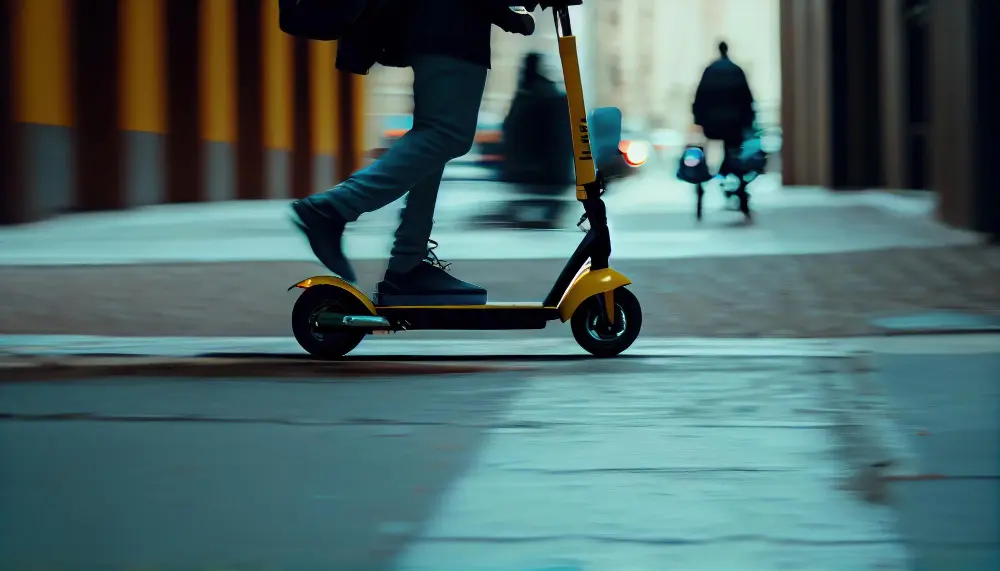
The world is becoming safer in many ways — fewer traffic fatalities, fewer plane crashes overall — but humanity has a knack for tripping itself up. In this case, quite literally, thanks to a device that seems purpose-built to increase the frequency of falls. The e-scooter is celebrated as modern, hassle-free mobility.
The Medical Toll of E-Scooters
From a medical standpoint, it is a remarkably efficient instrument for turning even the shortest journey into a trip to the emergency room. Year on year, the number of reported e-scooter accidents in Germany has risen by 38.1 percent. In 2025, police recorded, according toDestatis16,496 e-scooter accidents involving personal injury, and 38 people died.
Data from Munich tell the same sobering story. In astudy from Munich's TUM University Hospital rechts der Isar, 12% of injured e-scooter riders suffered a traumatic brain injury and 2% an intracranial hemorrhage. Facial injuries occurred in 42% of cases, midface fractures in 12%, and dental injuries in 18%.
The latest figures from the trauma registry of the DGU (German Society for Trauma Surgery) have been continuously analyzed in detail byPD Dr. Dr. Michael Zyskowski and his team, confirming a significant and consistent year-on-year increase in serious injuries caused by e-scooters.
Alcohol, E-Scooters, and Faith in One's Own Abilities
As if all of that weren't discouraging enough, human ingenuity inevitably enters the picture as well:
Alcohol combined with an e-scooter is a reliable fast track to trauma and neurosurgery. Anyone who, after a few too many drinks, is firmly convinced they still have adequate balance, reaction time, and hazard perception on a small board with two tiny wheels is sorely overestimating their cognitive abilities.
The Munich data make a compelling case thatalcohol not only increases the likelihood of an accident but also worsens the injury profile. Among intoxicated riders, the rate of traumatic brain injury or intracranial hemorrhage was 29%, compared with 8% among sober riders. Facial injuries and jaw and midface fractures are also significantly more common among intoxicated riders of these electric micro-vehicles.
Two Riders, a Smartphone, and Headphones
Things become even more predictably disastrous when two people squeeze onto a device designed for one. This shifts the center of gravity, compromises balance and controllability — and in the event of a fall, doubles the number of people whose anatomy may require surgical attention. Einstein was already well aware of the boundlessness of human stupidity; fortunately, he never lived to see the electric scooter.
Amid all these physical challenges, the smartphone is never far away. Anyone who takes calls while riding — or, better yet, conducts video calls — turns their already limited attention into a multitasking experiment. In a case-control study, mobile phone use immediately before a traffic accident was associated with a tripling of the probability of injury.
Headphones or earbuds are another inspired choice: you travel at above-average speed through a below-average traffic situation while deliberately blocking out acoustic warning signals. A German observational study of 4,514 cyclists and e-scooter riders found that headphones and earbuds were the most frequently observed secondary activity — which, predictably, leads to significantly more accidents.
The Combination Is What Makes It Dangerous
The medical takeaway is actually quite straightforward: e-scooters are not inherently dangerous — what makes them dangerous is the combination of a physically unstable vehicle, a lack of protective equipment, alcohol, distraction, and boundless overconfidence. Put simply, most riders are not cognitively equipped to control the scooter adequately.
Anyone who rides sober, alone, attentively, in daylight, on a dry road, with both hands on the handlebars and at a sensible speed can sidestep all of these risks. Those who also put in some physical effort may even get a training benefit out of it.
Do We Even Need E-Scooters?
A ban on rental scooters — as Paris has demonstrated since 2023 — has had purely positive effects: fewer accidents and less urban blight from scooters left as tripping hazards on pavements. The fish in the city's rivers would also be grateful for fewer heavy metals leaching from the hundreds of scooters sunk through acts of vandalism.
Anyone standing drunk on a scooter at night with a passenger, wearing headphones while texting on WhatsApp, is conducting a thoroughly modern mobility experiment. This can even result in the socially manageable early death of the rider — practiced Darwinism. If the rider were endangering only themselves, one could cynically frame this as an unambiguous positive.
Severe penalties would be a sensible starting point for reducing the pointless burden on public welfare systems, with an outright ban being the next logical step.