- Berlin
- Innovative Orthopedics & Sports Orthopedics
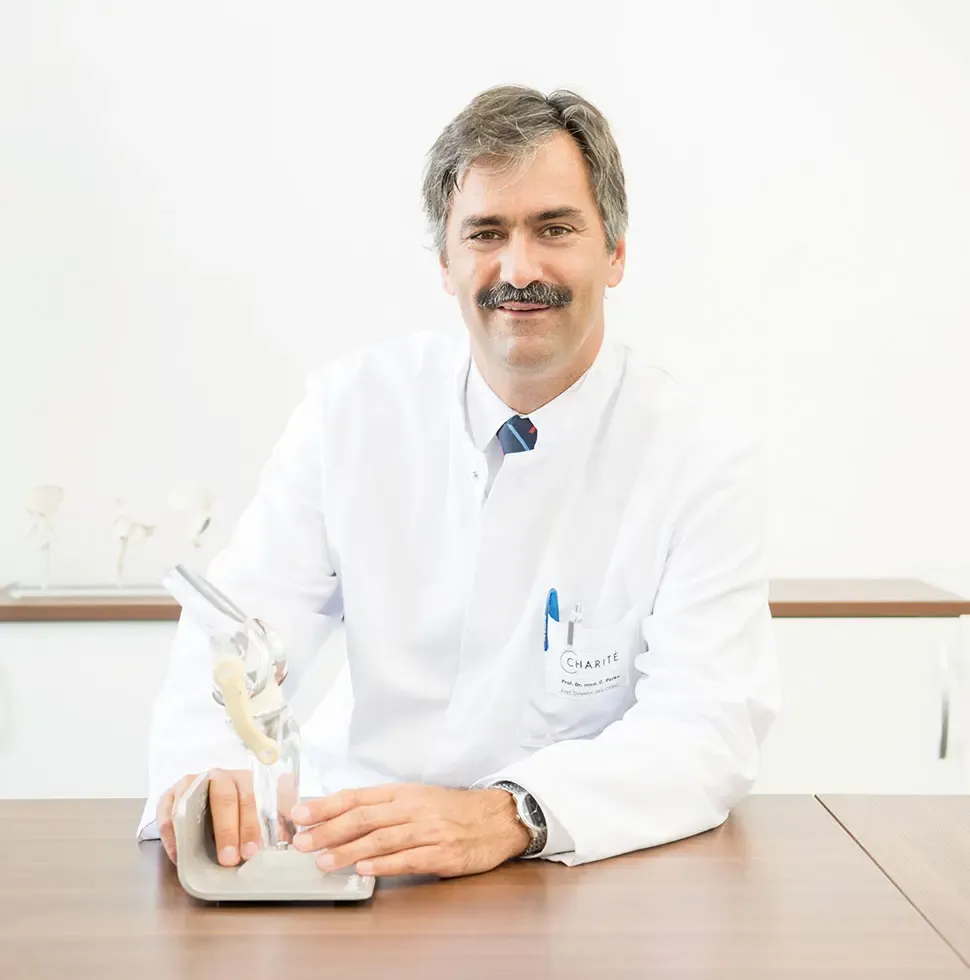
Univ.-Prof. Dr. Carsten Perka
Centrum für Muskuloskeletale Chirurgie (CMSC) Charité Berlin
Services
Experte auf Weltniveau
Von Orthopäden glaubt man gern, dass sie eine sportliche Vergangenheit haben. Auch wer Prof. Dr. Carsten Perka das erste Mal sieht, meint einen Profisportler zu treffen: Fast zwei Meter groß und breites Kreuz – ein ehemaliger Schwimmer oder Ruderer vielleicht? Tatsächlich spielte der Ärztliche Direktor des Centrums für Muskuloskeletale Chirurgie (CMSC) der Charité – Universitätsmedizin Berlin einst erfolgreich Handball, war sogar Vizemeister der DDR. Seine sportliche Karriere endete jedoch abrupt, als er sich mit 15 Jahren bei einem Skiunfall schwer verletzte.
Für den menschlichen Körper und seine Leistungskraft interessierte sich Perka auch nach dem sportlichen Aus. Sein Vater, ein Bauunternehmer, habe ihn auf die Idee zum Medizinstudium gebracht, erzählt der gebürtige Spreewälder. Dass er den Einstieg in die Orthopädie wählte, ist dem Glück der Wendezeit zu verdanken: Als Perka sich 1989 an der Charité bewarb, hatte der Run auf die renommierte Klinik noch nicht eingesetzt, und er bekam sofort eine Stelle.
"If you believe you can do it, it becomes dangerous – for you and for the patient."
Heute ist Perka der Endoprothetiker, dessen fachliche Meinung in Deutschland und international zählt. Dabei hat der 54-Jährige die Charité nie länger verlassen: Hier studierte er, schrieb seine Doktorarbeit, wurde Facharzt, habilitierte und ist seit 2015 einer der beiden Leiter des CMSCs. Hatte er nie Lust, sich andernorts zu entwickeln? „Ich spiele bereits im besten Team, warum also den Verein wechseln?“, begründet der Mediziner seine Treue. Deutschlands größte Uniklinik biete ihm alle Möglichkeiten: Er leitet ein großes Team mit vielen Spezialist:innen, kann hochrangige Forschung betreiben und klinisch arbeiten.


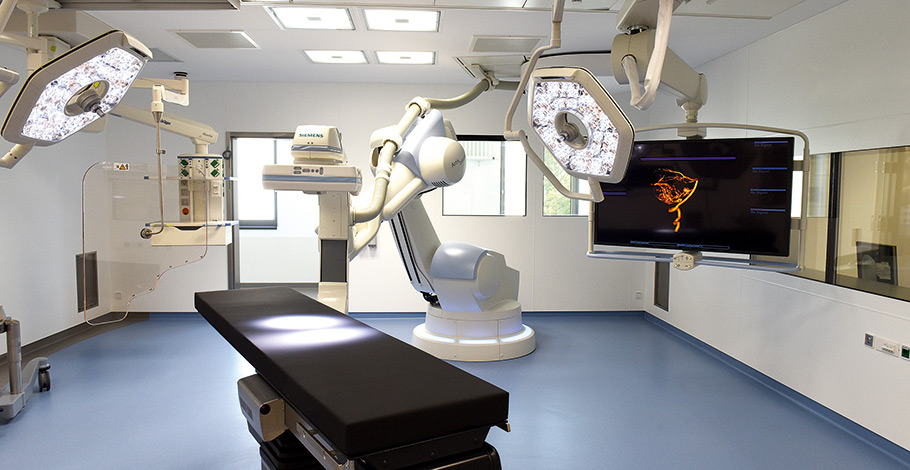

In 2019 alone, Perka and his colleagues performed around 1,400 endoprosthetic procedures on hips and knees. Nearly a quarter of these were operations where an implant had to be partially or completely replaced. Patients from home and abroad specifically seek out the Berlin specialist when a prosthesis loosens or becomes infected. "Together with the Hamburg Endo-Clinic, we perform the most complex endoprosthetic procedures," explains the orthopedist. "We also see many patients with serious general illnesses that other colleagues do not want to operate on."
Six years ago, the Berliners opened the first university special ward in Germany for people with infected joint prostheses. Here, they help over 90 percent of those affected achieve a germ-free joint; internationally, the healing rate is 60 to 70 percent.
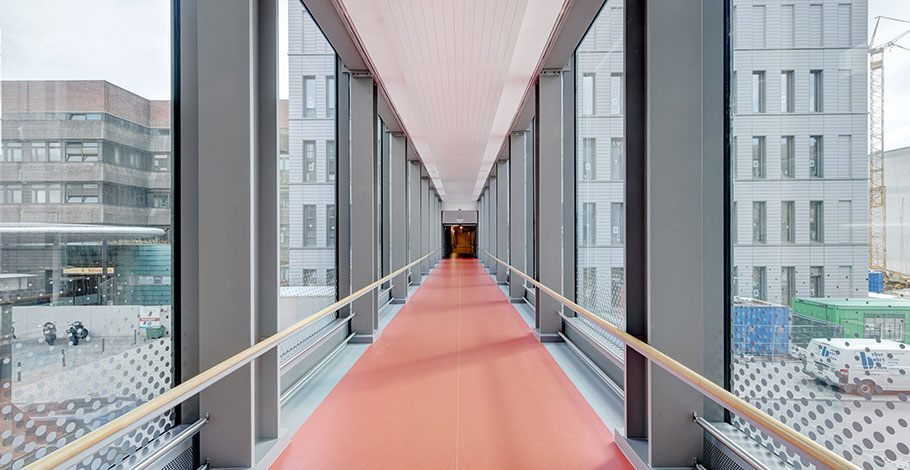
Patients who choose the CMSC for their first implant or a revision prosthesis are not only treated by the best surgeons. At the Charité Mitte campus, they can expect Europe's most modern hospital building for recovery: The 21-story ward building was newly opened at the end of 2016 after three years of core renovation. The facilities of the wards and rooms correspond to the latest findings and are oriented towards the well-being of the patients; from the upper floors, one can enjoy a unique view over the capital.
"The endoprosthetics of the hip is 15 years ahead of the knee, and furthermore, the biomechanics of the hip are simpler."
Experience stands safety of his patients always first. He rejects implants for which there are no valid data yet. However, if convinced by an innovation, he follows its development with interest - and uses it. Four years ago, for instance, the CMSC introduced a new knee prosthesis. "This implant comes closest to the anatomy of a healthy knee of all the models," Perka is convinced. With the previous knee prostheses, 10 to 20 percent of patients experienced discomfort - not a satisfactory rate. It is different with the new artificial joint: "Function and movement comfort are noticeably better for the patient compared to conventional prostheses."
In surgical technique, the physician remains true to tried and tested methods. Thus, after a test phase, his team currently operates without the support of surgical robots. The reason is simple: "The technology cannot achieve more than we can with conventional instruments," says the endoprosthetist. However, Perka can well imagine that he will soon switch to modern developments here as well: "It becomes exciting when the robot supports the surgeon with biomechanical data from the patient, suggesting the milling path and showing the resulting range of motion." The technology is particularly suitable for borderline and extreme cases, such as dancers who need to be extraordinarily flexible in the hip without the prosthesis stem popping out of the socket or the prosthesis and socket touching and thus causing too much wear.
Perka's surgical results are so good that many dancers and athletes put themselves in his hands. They often come with wear and tear that these extreme performances entail: "It is the quick movements and abrupt stops like in handball that damage the cartilage and necessitate an artificial joint," Perka knows. Nevertheless, he occasionally still picks up the ball himself.