© Freepik
March 10, 2026
PMC Redaktion
Prof. Dr. Christopher Bohr explains how the larynx works and how modern implants can permanently restore the voice in patients with vocal cord paralysis

© PMC
With
Prof. Dr. Christopher Bohr
What makes us unique as a speaking species – and what happens when this small, hidden organ fails? Prof. Dr. Christopher Bohr took the participants of the PMC Conference 2026 on a fascinating journey through the most complex valve of the human body.
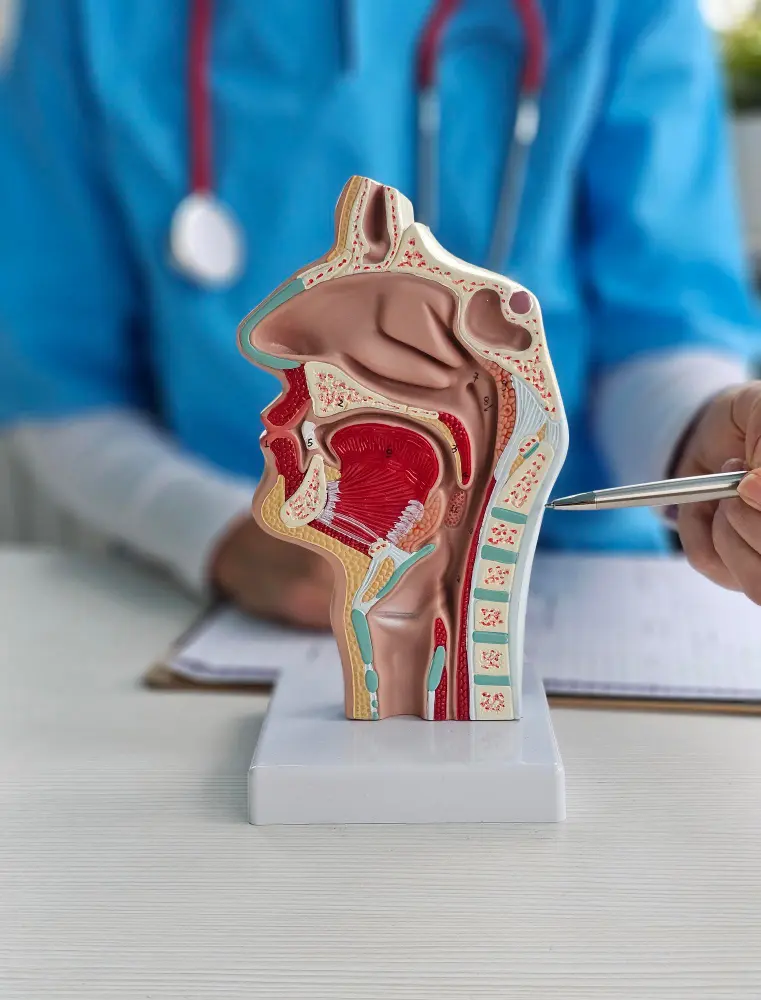
In the middle of the throat, well hidden and protected by a hardening cartilage framework, sits an organ to which we rarely give the attention it deserves: the larynx. Bohr began his lecture with a clear statement about its basic biological function: “In the world of animals, it is just a valve – the valve that is supposed to prevent liquids or food from entering the lungs during swallowing and causing inflammation there."
In humans, evolution has developed this simple closing mechanism into something far more complex. The larynx is equipped with a highly complex muscle system, all muscles supplied by the same nerve. Its strategic location below the chin also protects it from external impacts: “That's why laryngeal injuries are rare – but when they occur, they can cause serious harm," said Prof. Bohr.
Voice formation is a physical feat. The lungs produce a continuous airflow when exhaling – the larynx converts this into a periodically pulsed airflow that arrives as a sound wave in the ear. The throat, oral cavity, tongue, and palate shape it into vowels, consonants, and finally speech. The frequency at which this must occur is impressive: “The driving force is the exhaled air from the lungs. It has to be interrupted periodically – for me, about 150 times per second,” said Prof. Bohr.
Active muscle control with 150 impulses per second is biologically impossible – the vocal cords vibrate passively. A dynamic balance between muscle tone and the air pressure from below causes the system to resonate. Prof. Bohr explained the principle with an illustrative comparison: “Similar to a lid on a pot: When the pressure has exactly the same mass as the lid, the lid lifts – pressure escapes, the lid falls back down. Vibration occurs.”
This principle was first scientifically described in 1958 by Janwillem van den Berg – at the same time, a researcher in Erlangen filmed the vibration with a stroboscopic camera. “The two of them then said: OK, so that's obviously how it works,” summarized Dr. Bohr.
To maintain a healthy voice tone, three components must be balanced: the laminar flow as the main component, the tissue-induced sound, and the edge turbulence at the edges of the airflow. If this balance is disrupted, hoarseness occurs – in the worst case, the voice completely fails.
Vocal cord paralysis is one of the most significant impairments in the ENT field. Bohr spoke openly about the societal dimension: "It is unimaginable how much the quality of life suffers when we no longer have a voice. Our society is absolutely designed for our voice to function. It has never been more important than today to have a good voice."
In the case of paralysis, the affected muscle atrophies, the volume of the vocal cord decreases, the elasticity diminishes, and the position changes unfavorably. The goal of treatment is to restore volume, ensure the correct position, and improve tissue firmness.
The first treatment option is an injection of hyaluronic acid directly into the vocal cord. The procedure immediately creates visible volume and moves the cord back to the center. "The patient actually has the opportunity to form a voice again. But hyaluronic acid breaks down quickly – after six weeks, everything is back to how it was before." so the physician.
The search for a permanent solution led to the development of silicone implants that are inserted through a small window in the larynx. Since every larynx has individual dimensions, each implant initially had to be manually adjusted. A new generation makes this process unnecessary: "This silicone cushion can be filled with water and thereby made different sizes. You can readjust – and that is a very big advantage," explained Prof. Bohr.
The fillable implant allows the filling level to be adjusted even weeks after the operation through a simple injection. After the swelling subsides, the precise positioning of the vocal fold can be accurately corrected.
Prof. Bohr drew a clear conclusion: "I have much more freedom and significantly better and more consistent results with this implant. It can actually be used very standardized." What began as a complex, individually carved intervention is today a standardizable procedure with predictable results.
Voice is more than sound – it is social participation, identity, and a professional foundation. Dr. Bohr concluded: "Voice is a really complex construct made up of several components – but incredibly important for us in everyday life." With current surgical options, the path back to voice is now shorter, safer, and more precise than ever before.